Background
Our client is an energy technology company that operates a B2B2C platform for energy providers. The platform enables billing and settlements, account management, energy purchasing, and digital self-service portals for end customers.
Built around nearly 30 independent microservices, the platform supports multiple business domains and has grown significantly over time. As the system evolved, maintaining consistent architecture, performance, and engineering standards across dozens of services became increasingly difficult. Modernizing the platform manually would have required significant engineering effort, longer delivery timelines, and additional development resources.
Instead of scaling the team, the client partnered with Reenbit to explore how autonomous AI engineering could boost a senior developer’s productivity while maintaining high engineering quality and architectural consistency.

Challenges
Years of continuous development had introduced technical debt across many backend services. Common issues included inefficient Entity Framework Core queries, unnecessary data retrieval, redundant processing, inconsistent architectural patterns, and tightly coupled components. Together, these problems increased database load, slowed API response times, and made future enhancements more difficult.
The platform’s scale presented an additional challenge. Applying architectural improvements consistently across approximately 30 independent services would be difficult even for a large engineering team.
Traditional AI coding assistants also proved insufficient. While tools such as GitHub Copilot accelerated repetitive development tasks, they still required constant developer supervision and lacked the contextual understanding needed for large-scale architectural modernization. Early experimentation with pre-built autonomous agent frameworks demonstrated the potential of AI-driven development but introduced high operational costs and limited scalability.
The client needed an approach that could:
- modernize services consistently across the entire platform;
- preserve architectural standards and code quality;
- automate repetitive engineering work while keeping human oversight;
- scale senior engineering expertise without expanding the development team.
Solution
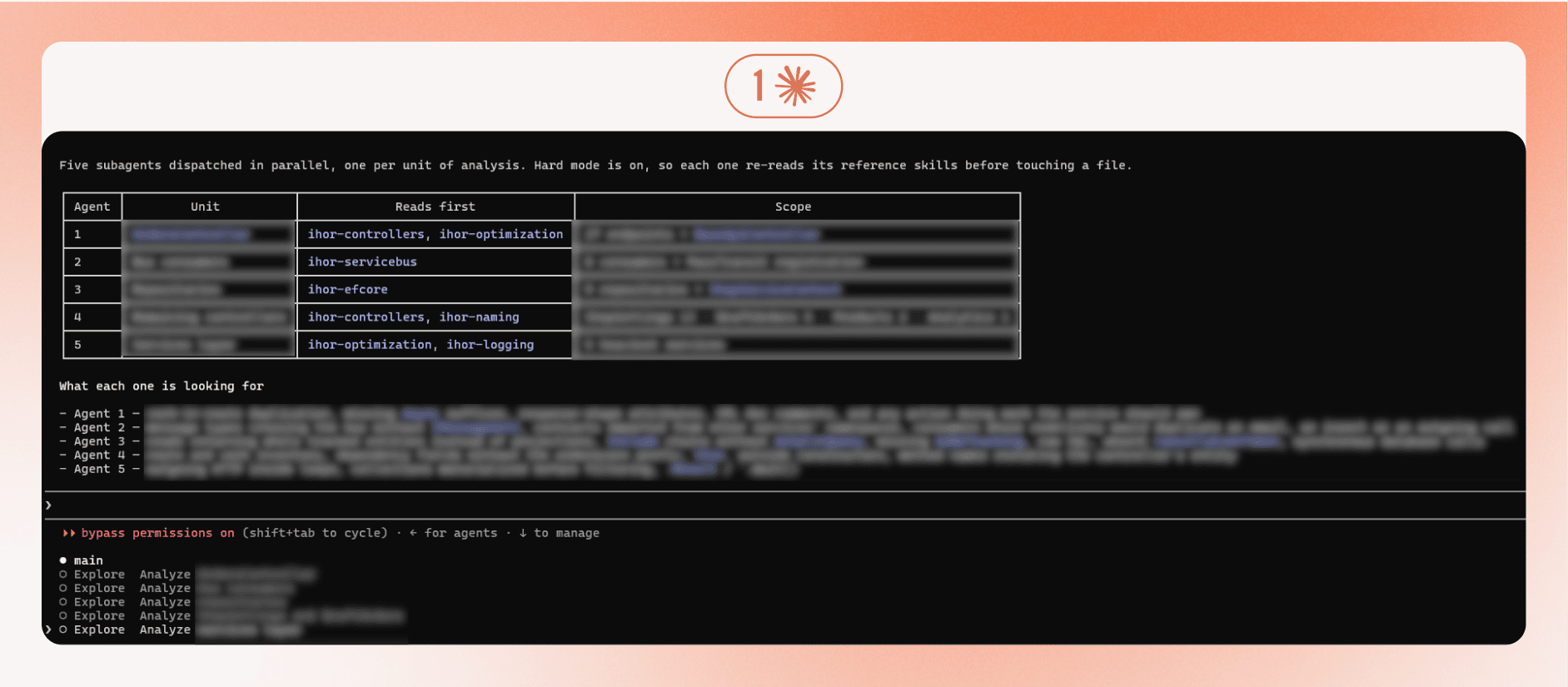
Reenbit designed and implemented a custom autonomous AI engineering workflow built on Claude Code. Rather than functioning as a traditional coding assistant, the solution operates as an engineering agent capable of executing complete modernization cycles under human supervision.
The AI agent performs documentation, architecture analysis, implementation, testing, quality assurance, and code review before preparing changes for engineer approval.
AI Engineering Knowledge Framework
To ensure consistency across all services, Reenbit created a reusable engineering knowledge base consisting of approximately 40 specialized skills covering:
- C# development standards
- Entity Framework Core optimization
- Architecture and design principles
- Dependency injection
- API development
- Logging and monitoring
- Background jobs
- Testing strategies
- Git workflow
- Performance optimization
- Quality assurance
The framework separates universal engineering practices from project-specific knowledge, making proven standards reusable while preserving service-specific business rules.
Service Discovery & Technical Audit
Before modifying any code, the agent analyzes each service to build a structured profile containing:
- architecture overview;
- dependencies and integrations;
- service responsibilities;
- call flows;
- business constraints;
- technical documentation.
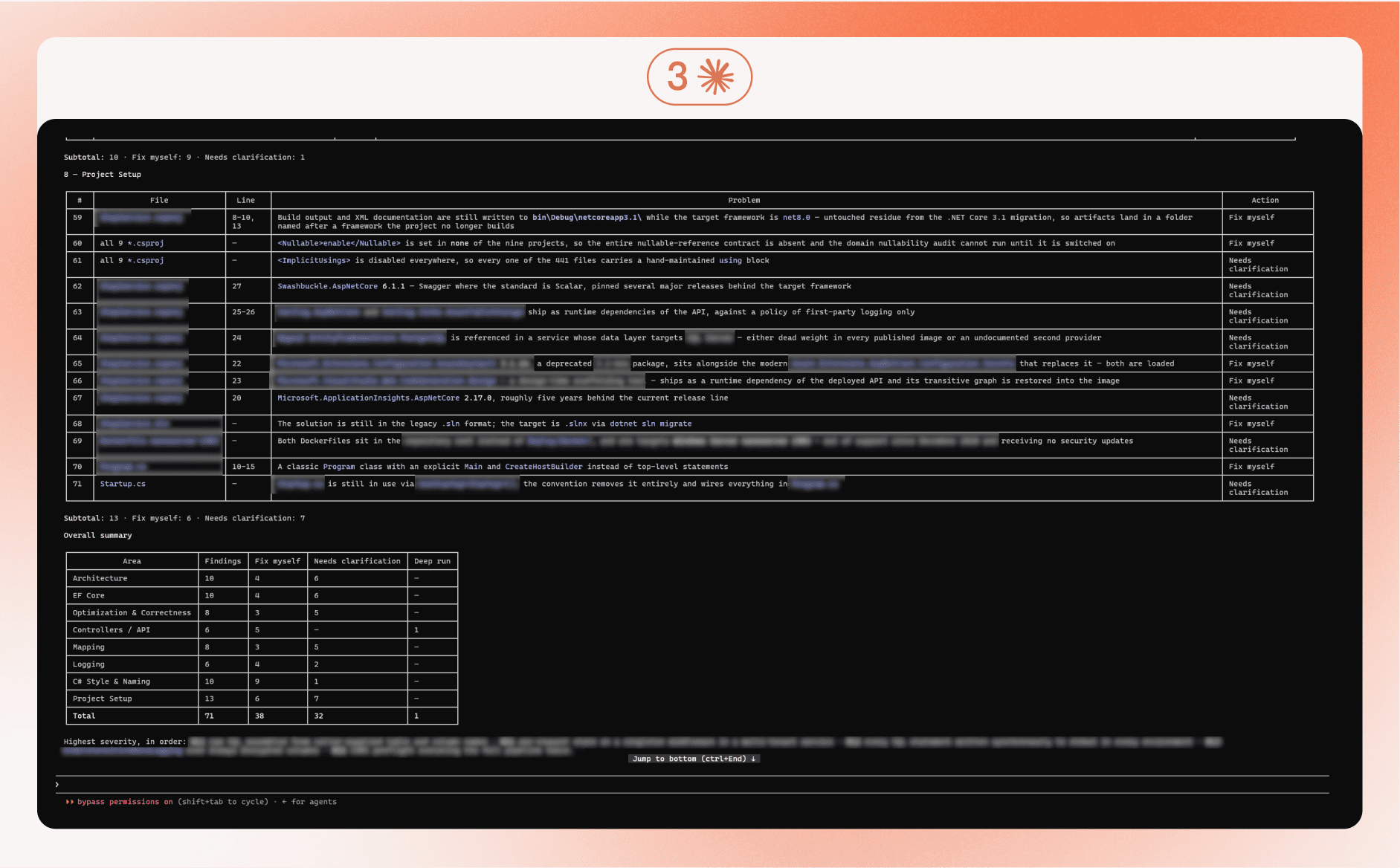
The agent then performs a comprehensive technical audit covering architecture, performance, Entity Framework Core usage, code quality, mapping, testing, and maintainability. Each finding is documented and prioritized before implementation begins.
Autonomous Modernization Workflow
The engineering agent supports two execution modes.
Ticket-driven mode follows developer-assigned tasks.
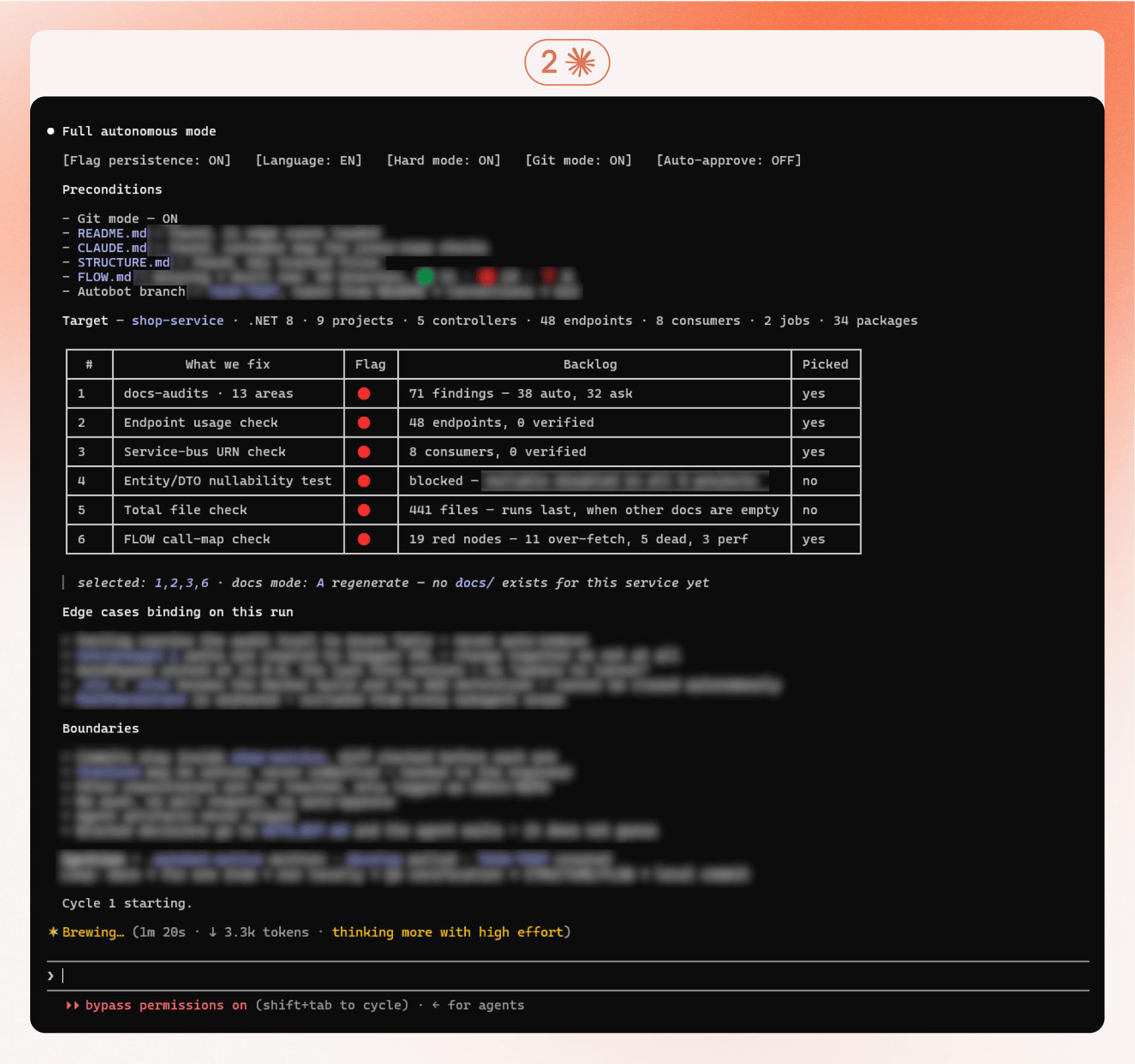
Autonomous mode independently selects issues identified during the audit, analyzes the affected code, applies modernization rules, updates tests, validates results, and prepares logical Git commits for engineer review.
Depending on task complexity and available token limits, the agent can operate autonomously for six to eight hours while modernizing multiple services in parallel.
Automated Quality Assurance
Every modernization cycle includes automated verification.
The agent:
- builds and runs backend services locally;
- validates APIs and integration scenarios;
- executes end-to-end browser testing with Playwright;
- analyzes console errors and network requests;
- automatically fixes detected issues before repeating validation.
This continuous verification loop significantly reduces manual testing effort while maintaining delivery quality.
Architecture Modernization
Across the platform, Reenbit introduced a standardized four-layer architecture consisting of:
- Domain – entities, DTOs, events, and contracts
- Infrastructure – DbContext, repositories, EF Core configuration, projections, Unit of Work
- Services – business logic, integrations, interfaces, mapping
- Web API – controllers, middleware, background jobs, consumers
Entity Framework Core was optimized using targeted projections, efficient query patterns, split queries where appropriate, and careful elimination of unnecessary data loading.
Thin controllers, explicit mapping, and improved change tracking further reduced complexity while improving maintainability.
Governance & Human Oversight
Although the engineering workflow is highly autonomous, critical decisions remain under developer control.
Safety mechanisms include:
- local Git commits only;
- no automatic pushes or pull requests;
- mandatory engineer review before merging;
- unresolved questions documented instead of guessed;
- human ownership of architecture, security, and final technical decisions.
Outcome
Business Impact
To ensure consistency across all services, Reenbit created a reusable engineering knowledge base consisting of approximately 40 specialized skills covering:
- 30× faster modernization compared with traditional development approaches.
- Large-scale architectural improvements delivered without expanding the engineering team.
Engineering Impact
- 90%+ of AI-generated code accepted during review without significant rewriting.
- 40–99% API response-time improvements across optimized endpoints.
- Operations previously requiring 30–40 seconds reduced to 3–6 seconds.
- Approximately 25 endpoints analyzed, redesigned, and optimized in a single day.
- Around 40 reusable engineering skills created to standardize development across services.
- Three microservices modernized concurrently through autonomous execution.
- 6–8-hour unattended engineering sessions covering documentation, implementation, testing, QA, and commit preparation.