
Lviv AI Day 2026: AI ROI, Multi-Agent Systems, and Healthcare Integration
The question that defined Lviv AI Day 2026 wasn’t “Can AI do this?” — it was “Should it, and can you prove the business case?”
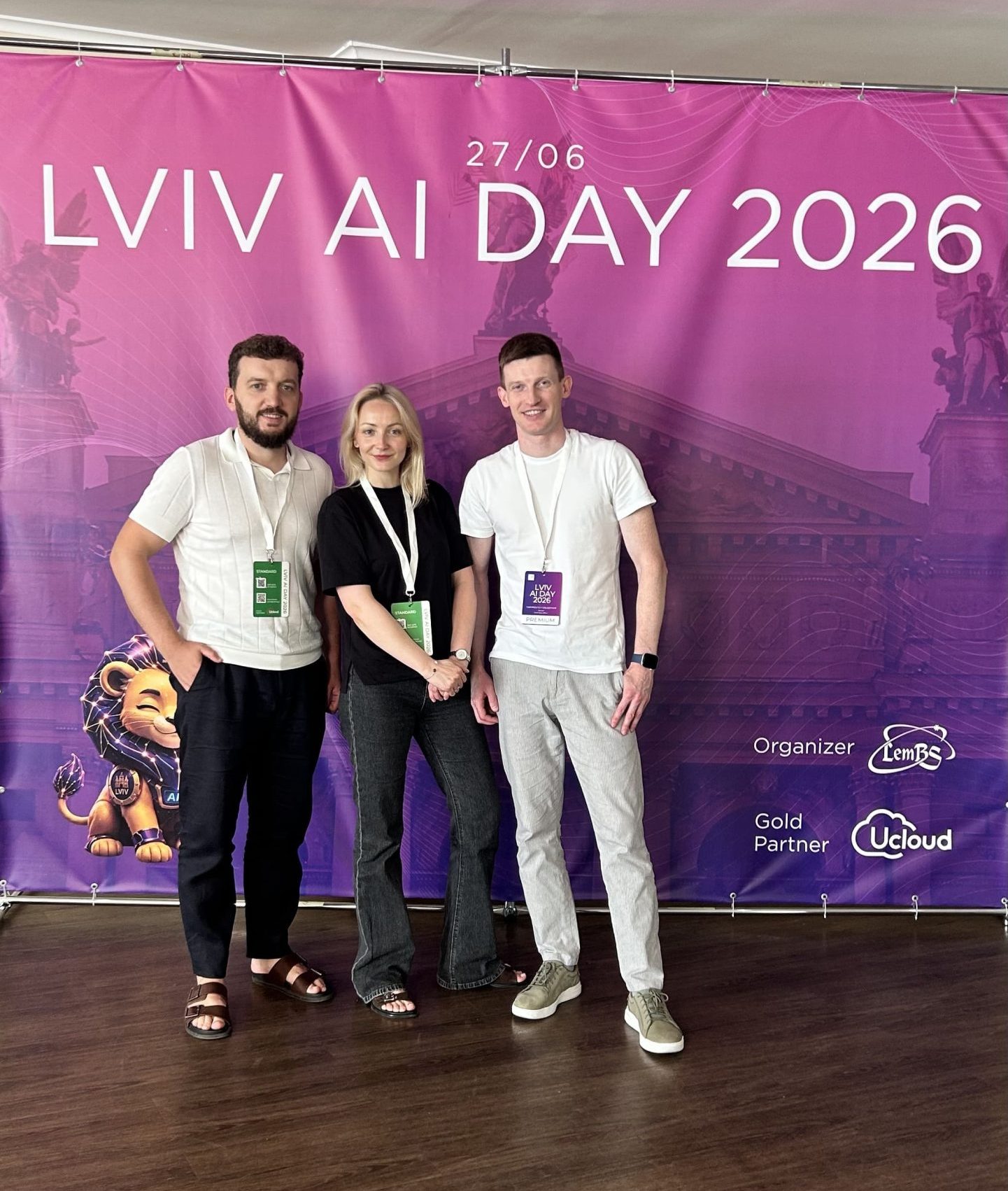
On June 27, 2026, over 400 participants gathered in Lviv for Ukraine’s leading Data Science and Machine Learning conference, organized by AI & BigData Day and Lemberg Tech Business School. Reenbit team was among the attendees — alongside ML engineers, data scientists, product managers, and founders from across Ukraine and beyond.
Two parallel tracks — Data Science Solutions and Machine Learning — 20 speakers, three panel discussions. What emerged wasn’t a celebration of AI’s capabilities. It was a practitioner-led call to move from experiments to outcomes.
From Demo to Scale: The AI ROI Problem
The opening panel set the tone immediately. Oleksandr Krakovetskyi (DevRain, Microsoft AI MVP), Oleksandr Romaniak (Aimtraction), and Ross Chayka (Lviv Startup Club) laid out an uncomfortable reality: most AI initiatives in 2026 still fail to deliver financial results.
Oleksandr Romaniak’s session, “From AI Experiments to Financial Results,” gave a direct framework:
- Identify processes where AI creates measurable economic value, not just automation
- Calculate ROI before implementation, not after
- Define a transformation roadmap for 30–90 days with specific financial targets
- Know when to stop — not every process needs AI
AI Second Brain: Context Beats Content
Andriy Bilous (StayInno, CEO; Microsoft MVP in AI) challenged the default enterprise AI model. Most corporate deployments are “ChatGPT on documents” — retrieving similar chunks without understanding who owns what, how processes connect, or how decisions flow.
His alternative: a Knowledge Graph-based AI Second Brain built on the company’s own ontology. Instead of document search, the system understands relationships between teams, processes, and decisions. The result is AI that doesn’t just retrieve — it helps manage.
AI That Doesn’t Die on Monday
Andrian Yablonskyy (AdSystem.PRO) named the production reliability gap clearly: AI regularly performs well in demos and fails under real conditions — unexpected inputs, missing data, changed business rules.
His principles for teams building production AI:
- Know what you’re building before you start
- Measure effectiveness — understanding what doesn’t work is often the fastest path forward
- Automate routine, not judgment
- Map the limits before deployment
AI in Healthcare: Integration Is the Real Bottleneck
Bohdan Khaietskyi (Tayra.AI, CPO; CEO of a 5-clinic medical network with 12,000+ monthly procedures) made the clearest case of the day: medical AI doesn’t fail at the model level. It fails at integration.
Healthcare systems are fragmented — every clinic runs different software with different field structures, ICD-10 directory variants, and permission models. Tayra builds an AI layer between patient, physician, and MIS that maps model outputs to each system’s specific structure, handles format variations, validates outputs, and routes physician confirmation — working inside systems used by 95,000+ Ukrainian physicians.
In healthcare, tools built for workflow integration achieve adoption. Tools built for benchmark performance stay in research.
AI Content in High-Stakes Contexts
Anna Baum (Anna Baum Studio, AInfluencer) builds AI content pipelines for Ukraine’s Ministry of Defense — a context where hallucinated or unverified output isn’t just embarrassing. Her architecture: orchestration + grounding + verification, with the model explicitly instructed to say “no” when confidence is insufficient. For any domain where errors carry real consequences — legal, medical, financial, defense — this isn’t optional. It belongs in the design from day one.
Machine Learning Track: Key Takeaways
Vitalii Pavliuk (Preply, Senior Back-End Engineer) described the shift in engineering: the role has moved from writing boilerplate toward architectural design and AI-output review. His warnings — security risks from AI-generated code are real, hallucinations in code generation are structural not exceptional, and high-velocity development erodes architecture quality without deliberate governance.
Serhii Babich (DataRobot) addressed a hiring reality: candidates who use AI to prepare interview answers don’t necessarily have the engineering judgment the role requires. His session proposed approaches that reveal how candidates actually think and debug — not just prompt.
Vladyslav Melnyk (Automat-it, Principal MLOps Engineer) presented a real production case: a travel concierge with four specialist agents on AWS using Strands SDK, Bedrock, and AgentCore. His key finding — observability drove every architecture decision, not assumptions. Multi-agent patterns (orchestrator, swarm, graph, A2A) each fit different use cases. Most real problems need a well-instrumented orchestrator, not a swarm.
Oleksandr Krakovetskyi (DevRain) covered LLM API mechanics at production scale: temperature, top-p, seed parameters, caching for context reuse, and the trade-offs between standard and reasoning models for different task types.
Dmitry Prokopiev (UCloud) made the case for TensorRT-LLM + cloud GPU as the path from experiments to real-time AI products. In 2026, conversational speed isn’t a feature — it’s the baseline expectation.
Renat Gilmanov (EPAM Systems, Director of AI & Knowledge-Powered Solutions) closed the ML track with a framework for generating complex, high-quality AI outputs without proportionally increasing cost: rich domain knowledge + expert reasoning approaches + token-efficient generation. Structured knowledge bases and ontologies improve accuracy. Pipeline patterns that guide structured thinking improve reliability. Token discipline — chunking, caching, prompt compression, right-sized model selection — keeps production costs viable at scale.
The Human Decision Is Not a Workaround
Across both tracks, one principle was consistent: the final decision belongs to a human. Not as a temporary limitation — as a design requirement. Agents and automation require oversight because the cost of unreviewed errors in medical, financial, defense, and legal contexts is measured in outcomes that matter.
Only 41% of AI agent deployments reach positive ROI within 12 months, and 19% never reach payback — almost entirely due to governance gaps and unmeasured rework, not agent capability (Gartner Agentic AI Pulse 2026). Human review built into the architecture — not bolted on — is what separates the 41% from the rest.
“The final decision should always belong to a human. Today, between panel discussions, I prepared my daughter for her gymnastics competition — hair bun, stage makeup, words of encouragement. Some moments can’t be replaced by AI.”
FAQ
What is Lviv AI Day 2026?
A one-day AI and data science conference by Lemberg Tech Business School and AI & BigData Day, held June 27, 2026 in Lviv, Ukraine. 20 speakers, 2 tracks, 400+ participants
What were the main themes at Lviv AI Day 2026?
AI ROI and financial justification, moving from pilot to production, process mining before AI adoption, healthcare AI integration, multi-agent architecture, token-efficient generation, and human oversight in AI systems.
What is a multi-agent AI system and when should you use one?
Multiple specialized agents coordinating to complete complex tasks — using orchestrator, swarm, graph, or A2A patterns. Per Vladyslav Melnyk (Automat-it), architecture decisions should be driven by observability data, not assumptions. Most production problems need a well-instrumented orchestrator, not a swarm.
Should AI make final decisions autonomously?
No — consensus across all Lviv AI Day 2026 panels. Final decisions in high-stakes contexts belong to humans. AI systems should include explicit oversight, escalation triggers, and governance structures — especially in medical, financial, legal, and defense applications.

