
AI Week New York 2026: Key Insights on Agentic AI
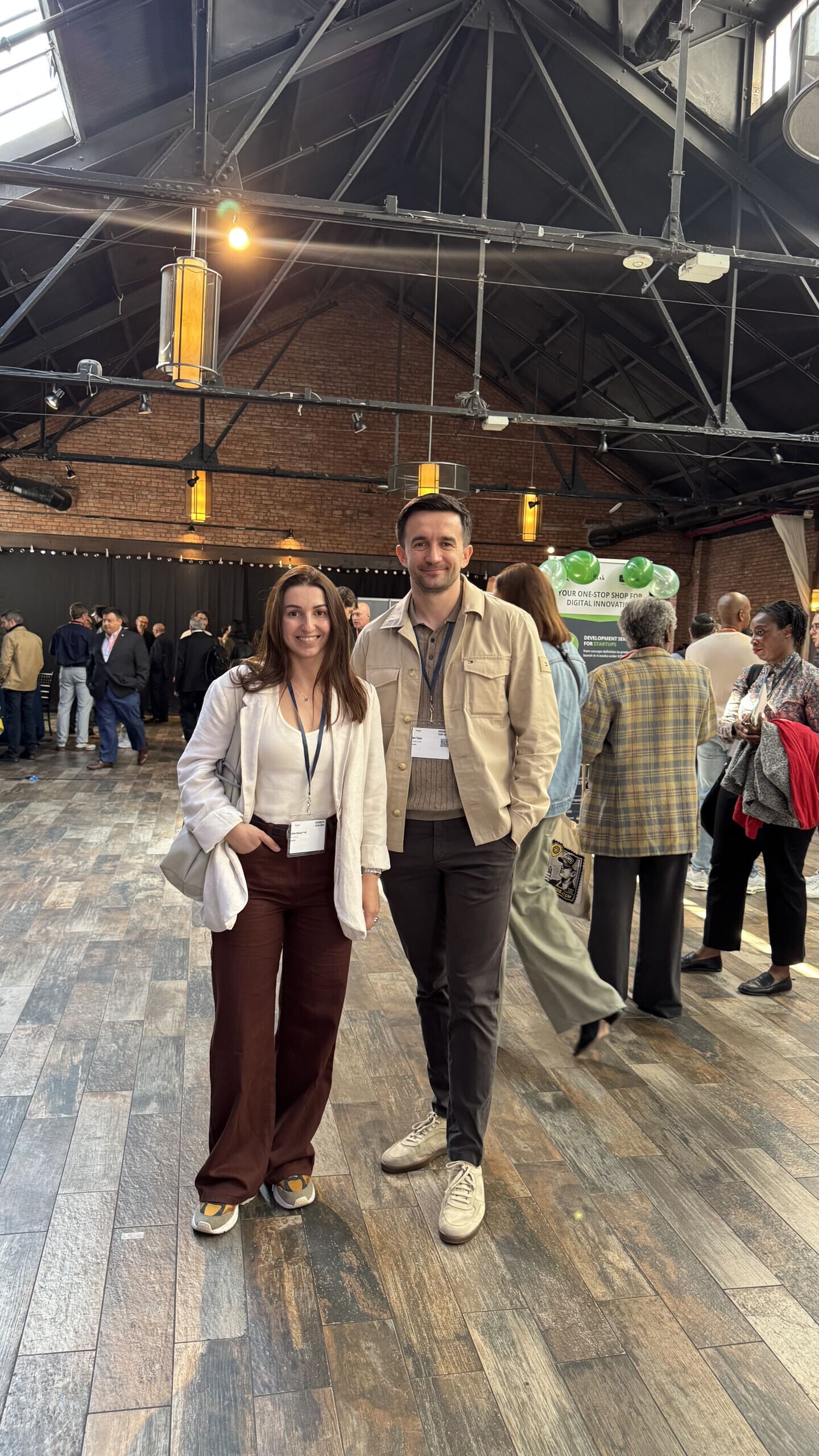
We spent a week in New York City at AI Week NY 2026 — a citywide festival that brought together thousands of founders, engineers, investors, and enterprise leaders to discuss where AI is actually going. This is what we heard, what stood out, and what it means for how we build software.
What Is AI Week New York 2026?
AI Week New York 2026 (Spring Edition) is a premier, community-driven AI festival organized by Pulse NYC, running May 11–17 across dozens of venues throughout New York City. Unlike traditional single-venue conferences, AI Week NY operates as a distributed, open-format festival: anyone can submit an event, attend multiple gatherings in a single day, and move freely between panels, workshops, hackathons, and networking sessions.
This year’s Spring Edition featured six thematic tracks:
- Creative Tech — generative AI in creative industries
- Startup Focus — tools and strategies for AI builders
- Social Impact — AI applications in health, climate, and society
- Enterprise Scale — implementing AI in large organizations
- Ethical AI — frameworks for responsible AI development
- Investor Match — connecting AI startups with venture capital
The event drew C-suite leaders, founders, engineers, investors, policymakers, and practitioners from startups, academia, and government — all in one week, across one city.
Theme 1: Agentic AI Has Left the Lab — It’s Now a Production Problem
The most repeated phrase across panels this week wasn’t “AI is the future.” It was: “From pilot to production.”
The conversation at AI Week NY has matured significantly from previous years. In 2024, people were asking whether AI would change software development. In 2026, the question is how fast organizations can operationalize what they’ve already prototyped.
One session — aptly titled “From Pilot to Production: Building AI That Actually Sticks” — captured this shift directly. The consensus: most AI pilots fail not because of the model, but because of the surrounding system. Data pipelines, governance frameworks, integration architecture, and human oversight structures must be in place before you scale.
This resonated with what enterprise practitioners across the week kept saying: the bottleneck is no longer capability, it’s control.
“The question comes down to: how deeply is AI embedded in your business processes? Is it a part of the enterprise? Or is it something on the side?” — Arvind Krishna, IBM Chairman and CEO, Think 2026
According to IBM’s Think 2026 recap, by 2030, 50% of operational decision-making is expected to be handled by AI. That number reframed many conversations this week: we’re not talking about augmentation anymore. We’re talking about redesigning how the business operates.
What “Agentic AI” Actually Means in 2026
Agentic AI refers to AI systems that act autonomously — perceiving inputs, making decisions, executing multi-step tasks, and adapting based on outcomes — without constant human direction. Unlike earlier generative AI tools that respond to prompts, agentic systems can initiate actions across tools, APIs, and workflows.
At AI Week NY, this definition came up repeatedly — because a lot of confusion still exists between “AI-assisted” and “AI-agentic.” The practical distinction matters enormously for enterprise buyers and engineering teams.
Gartner projects that by the end of 2026, 40% of enterprise applications will include task-specific AI agents — up from less than 5% in 2025. That’s not a slow curve. That’s a cliff.
Theme 2: The AI-Native Product Manager and the Changing SDLC
One of the standout sessions at the Brooklyn Tech Expo was delivered by Greg Spektor, who explored what it means to be an AI-native Product Manager in 2026.
The core argument: traditional PM tasks — drafting requirements, synthesizing feedback, writing specs — are rapidly being automated. The PM role doesn’t disappear, but it shifts. The value moves from documentation to judgment: knowing which problems to solve, which tradeoffs to accept, and how to govern AI-generated work.
This connects to a broader pattern that came up again and again at AI Week NY: the software development lifecycle (SDLC) is being structurally redesigned.
From Anthropic’s 2026 Agentic Coding Trends Report:
“2026 is poised to be the year when the systemic effects of this evolutionary shift reconfigure the software development lifecycle and reshape software engineering as a discipline.”
What does this mean in practice? Engineers describe using agentic AI for easily verifiable tasks — such as boilerplate generation, test scaffolding, and documentation — while retaining ownership of the architecture, design decisions, and domain-specific logic. The result: faster feedback loops, tighter iteration cycles, and the ability to “surge” engineering capacity on-demand without proportionally scaling headcount.
For custom software development partners like Reenbit, this is a structural opportunity. AI-augmented teams deliver faster, with senior engineers focused on what AI can’t replace: judgment, context, and accountability.
Theme 3: Security and Trust Are Now Foundational, Not Optional
The Security Leaders Breakfast was one of the more grounding sessions of the week. The premise was direct: as AI agents gain real access to real systems — databases, APIs, communication tools, customer data — the attack surface expands dramatically.
One panelist framed it sharply: “AI made forgery cheap and perfect.” (Jesse Tayler, featured at Brooklyn Tech Expo.) The shift from authority-driven to community-driven identity trust is becoming a serious design consideration for anyone building agentic systems.
Key themes from the security track:
- Agentic systems must have defined data access boundaries and approval rights before broad deployment
- Audit trails are non-negotiable in regulated industries (finance, healthcare, legal)
- “Black box” AI implementations are increasingly incompatible with enterprise risk management
- The AI Expo 2026 recap from Artificial Intelligence News put it clearly: the finance, healthcare, and legal sectors have near-zero tolerance for error.
- Responsible AI in these fields relies on accuracy, attribution, and integrity.
This theme — responsible AI as a delivery requirement, not a compliance checkbox — ran through every enterprise-focused session at AI Week NY.
Theme 4: The Economics of AI-Augmented Development Are Shifting Fast
Several sessions explicitly addressed what agentic AI means for cost structures in software development. The numbers are significant.
McKinsey research cited at CIO shows that AI-centric organizations are achieving 20–40% reductions in operating costs and 12–14 point EBITDA margin increases, driven by automation, faster cycle times, and more efficient use of engineering talent.
These are projections, and real results depend heavily on execution. But the direction is clear: AI-augmented teams that can govern the output are becoming the competitive standard in custom software development.
The broader market data confirms the acceleration: LLM API pricing dropped 60–80% over the past 18 months, even as engineering complexity shifted to the integration and governance layers.
One point that resonated from a founder roundtable: the gap between teams that act in 2026 and those that wait until 2027–2028 is compounding. First movers are building institutional knowledge and client trust that latecomers will struggle to replicate.
Theme 5: AI for Good — Healthcare, Climate, and Social Impact
The Purpose Summit: AI for Community Resilience at Civic Hall and the AI for Good: Conversations in the Park session at Madison Square Park brought a different kind of energy — more reflective, more human.
Healthcare featured prominently. Accenture estimates that AI applications in healthcare can generate up to $150 billion in annual savings by 2026. The New York Academy of Sciences convened a separate symposium — The New Wave of AI in Healthcare 2026 — bringing together clinicians, researchers, and regulators to address how AI is reshaping diagnostics, treatment delivery, and patient outcomes.
Four in ten healthcare executives already use AI for inpatient monitoring and early warning systems. AI-powered imaging is projected to prevent up to 2.5 million diagnostic errors annually.
But the social impact sessions also raised harder questions — ones that didn’t have easy answers: Are we building better lives? (the literal title of one event). When AI reshapes who does what work, at what speed, for what cost — who benefits, and how do we govern it?
These conversations are no longer academic. They’re design decisions.
What We’re Taking Back to Reenbit
We came to AI Week NY as practitioners, not spectators. And the honest reflection is that the conversations happening in New York right now align with what we’re building and how we’re building it.
Reenbit works with US and Western European clients on complex custom software — healthcare platforms, enterprise integrations, data-intensive applications. The themes of this week — agentic workflows, governance-first architecture, security as a first principle, and the economics of AI-augmented delivery — are not abstract for us. They’re the conversations we’re having with clients every week.
A few things we’re doubling down on as a result of this week:
- AI-augmented delivery with senior accountability. We’re not replacing senior engineers with AI — we’re freeing them from tasks that don’t require senior judgment, so they can own more of what does.
- Governance as a product feature. For regulated industry clients (healthcare, fintech), AI governance — audit trails, access control, model explainability — is now part of the specification, not an afterthought.
- Custom over commodity. The trend is clear: companies that need serious AI integration need partners who understand their domain, not vendors pushing generic tools. That’s the Reenbit model.
If you’re navigating these questions on your own product or platform, we’d be glad to talk.
FAQ
What is AI Week New York 2026?
AI Week New York 2026 is a week-long, community-driven AI festival organized by Pulse NYC, running May 11–17 across New York City. It brings together thousands of tech leaders, founders, engineers, investors, and policymakers for panels, workshops, hackathons, and networking events. The Fall Edition is scheduled for October 5–11, 2026.
What is agentic AI and how is it different from generative AI?
Agentic AI refers to AI systems that act autonomously across multi-step tasks — perceiving inputs, making decisions, using tools, and adapting based on outcomes — without constant human direction. Generative AI responds to prompts; agentic AI initiates and executes actions. In enterprise software, this distinction determines whether AI augments a workflow or runs it.
What were the main themes at AI Week NY 2026 Spring Edition?
AI-augmented engineering teams can reduce QA costs by 60–75%, documentation overhead by 80%, and total project costs by 30–45%, while delivering 25–40% faster time-to-market. However, realizing these gains requires governance frameworks, senior engineering oversight, and careful integration architecture — not simply deploying coding assistants.
What should enterprise leaders do now to prepare for agentic AI?
Define data access boundaries, establish audit and compliance requirements, choose partners with production-proven agentic workflows, and avoid vendor lock-in by building multi-model flexibility into your architecture. Acting in 2026 creates a compounding advantage over organizations that wait.
Why is custom AI development better than off-the-shelf tools for enterprises?
Off-the-shelf AI tools require organizations to adapt their workflows to the software. Custom agentic AI development aligns the solution to actual customer journeys, regulatory requirements, and internal workflows — reducing risk and maximizing domain-specific impact.

