
Build vs Buy: Should You Rely on Off-the-Shelf AI Coding Tools?
The economics governing how we create, maintain, and scale software are undergoing a fundamental transformation. For decades, the basic calculus of tech leadership remained relatively static: human developers wrote code. Meanwhile, efficiency was achieved through better frameworks, Agile project management, automated continuous integration pipelines and more. Today, the extensive adoption of GenAI has profoundly changed this baseline.
This abrupt influx of AI capabilities has compressed the time required to move from initial concept to deployment. At the same time, it has introduced a new layer of operational and managerial complexity. As tech stacks grow increasingly reliant on such foundational models, tech leaders face an intensified version of a classic dilemma. The buy vs build AI software debate is now viewed through the complex lens of machine learning infrastructure.
The core question is not whether a team should write a feature in-house or subscribe to an external software vendor. Now, businesses must decide whether to:
- Orchestrate their development pipeline around a generic, commercial AI platform?
- Invest capital in engineering a proprietary, internally managed system customized to their unique architectural frameworks and domain-specific intelligence?
As organizations manage this shifting paradigm, their decisions will dictate infrastructure agility, engineering expenses, and intellectual property security for the next decade. Thus, choosing the wrong path risks an unsustainable long-term maintenance burden and increased reliance on external vendors that control your company’s digital infrastructure.
Grasping the Core Dilemma: Off-the-Shelf vs. Bespoke AI Tooling
Effectively evaluating the build vs buy AI decision is important for defining how each approach operates in modern enterprise environments.
What is “Off-the-Shelf” AI? (GitHub Copilot, Cursor, and Lovable)
An off-the-shelf approach uses publicly available SaaS products designed for a wide range of development workflows. These tools are built on large, generalized language models and are offered as accessible extensions or standalone development environments.
Effectively evaluating the build vs buy AI decision is important for defining how each approach operates in modern enterprise environments.
- GitHub Copilot. Integrated into standard development environments like VS Code and JetBrains, Copilot is one of the most advanced autocomplete tools. It assists in generating boilerplate code, writing unit tests, and suggesting relevant functions based on the active file.
- Cursor. Built on a fork of VS Code with an AI-first user experience, Cursor enables developers to reference entire repositories, interact with code using natural language, and perform multi-file edits. It uses advanced models to offer ongoing structural recommendations.
- Lovable. As a no-code/low-code platform powered by generative AI, Lovable provides non-technical users with the ability to build and update web applications by describing requirements in natural language. It automatically manages deployment, routing, and database setup.
The mentioned AI tools present low barriers to entry, seat-based subscription pricing, and quick time-to-value. Such tools are designed to support millions of users and handle standard implementation tasks through general-purpose programming.
What Does “Building Your Own AI” Actually Mean?
Conversely, building a bespoke AI system does not require training a large base model from scratch, which is financially impractical for most organizations. Instead, it involves taking ownership of the architecture, data context, and operational pipeline.
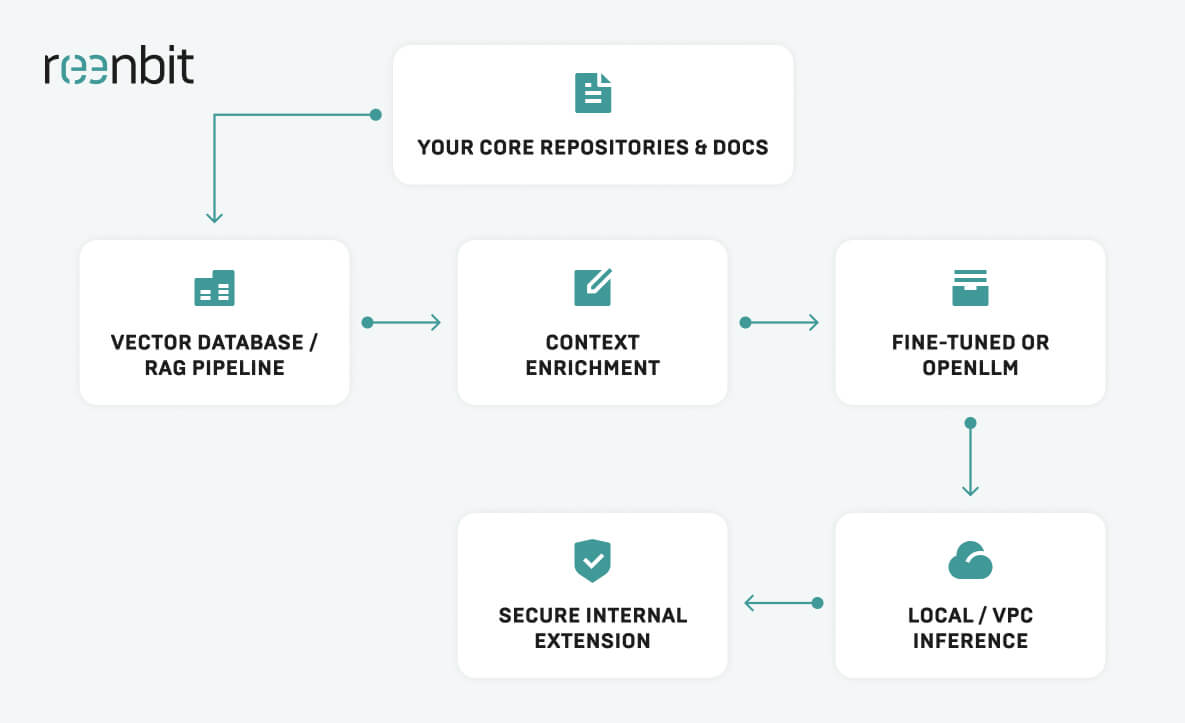
A custom-built system typically includes:
- Hosting Open-Weights Models. Deploy open-source architectures, like Llama-3 or Mistral, within the enterprise’s secure private cloud or Virtual Private Cloud.
- Advanced Context Injection (RAG). Build private Retrieval-Augmented Generation pipelines that provide the model with precise, real-time data from internal documentation, private APIs, legacy systems, and proprietary blueprints.
- Targeted Fine-Tuning. Train models on the organization’s historical codebase for capturing specific coding standards, domain logic, and niche programming languages not addressed by public models.
- Bespoke Integration Layers. Develop internal IDE extensions and code review automations that integrate with CI/CD pipelines, security compliance tools, and task management systems.
Building means creating a tailored internal asset that enables your firm to maintain control over token routing, context retrieval, prompt architecture, and system prompt parameters.

CHOOSE THE RIGHT AI TOOLING FOR YOUR ENGINEERING TEAM
Total Cost of Ownership (TCO): The Financial Reality Check
To get a true sense of what each choice costs, you must look past the initial software invoice or a developer’s base salary. A proper build vs buy decision matrix requires you to balance immediate outlays with the compounding, long-term expenses that surface down the road.
The Subscription Trap of Ready-Made SaaS Tools
On paper, paying for off-the-shelf AI tools looks like a bargain. Spending $20 to $100 per user per month feels like pocket change compared to the cost of hiring a senior engineer. But for mid-sized companies and scaling enterprise engineering teams, this linear pricing model comes with a catch.
As you roll such tools out to hundreds of software developers, QA engineers, and architects, those per-seat fees quietly snowball into a massive line item on your monthly budget. On top of that, you run into a serious lock-in risk. Once your engineering department builds its internal documentation, training workflows, and daily habits around a specific commercial platform, walking away becomes a massive headache.
When you entirely depend on an external solution, your organization is at the mercy of the vendor’s roadmap. Unfortunately, a vendor may raise prices, restructure service tiers, or tweak underlying API endpoints without warning. This will force you to absorb the relevant impact. Such a lack of strategic control over your core tools can further erode your product margins over time.
The Real Costs of In-House AI: Engineering Salaries, Infrastructure, and Model Drift
Building a custom alternative is an expensive investment that demands an honest assessment of upfront and ongoing capital requirements. The hidden costs of your build vs buy AI solutions strategy frequently surprise leadership teams who underestimate the specialized talent and compute resources required to maintain machine learning systems.
Cost Category
Expense Component
Financial Dynamic
Upfront Costs
Specialized Talent & Setup
High initial investments in hiring data engineers and AI architects to configure the initial RAG pipelines and model deployments.
Compute Infrastructure
Dedicated GPU Clusters
Continuous overhead from renting cloud-hosted GPU instances (e.g., NVIDIA H100s or A100s) to handle low-latency internal inference requests.
Maintenance Burden
Addressing Model Drift
Constant engineering hours required to update vector databases, retrain weights, and re-align the model as the company’s code repositories evolve.
Upfront Costs
Expense Component: Specialized Talent & Setup
Financial Dynamic: High initial investments in hiring data engineers and AI architects to configure the initial RAG pipelines and model deployments.
Compute Infrastructure
Expense Component: Dedicated GPU Clusters
Financial Dynamic: Continuous overhead from renting cloud-hosted GPU instances (e.g., NVIDIA H100s or A100s) to handle low-latency internal inference requests.
Maintenance Burden
Expense Component: Addressing Model Drift
Financial Dynamic: Constant engineering hours required to update vector databases, retrain weights, and re-align the model as the company’s code repositories evolve.
Over a multi-year period, these continuous investments in infrastructure and engineering can easily eclipse the cumulative subscription fees of a ready-made SaaS alternative. If your custom solution fails to deliver highly specific productivity gains, the project quickly shifts from a competitive advantage to an expensive internal sinkhole.
The “Vibe Coding” Paradigm: How AI-Generated Code Changes the Matrix
The embedding of AI into software development has created a new operational philosophy called “vibe coding.” It describes a workflow in which developers spend less time manually writing syntax and more time acting as high-level directors. Besides, this approach guides AI tools through conversational prompts, reviews automatically generated code blocks, and shifts engineers’ focus to system orchestration.
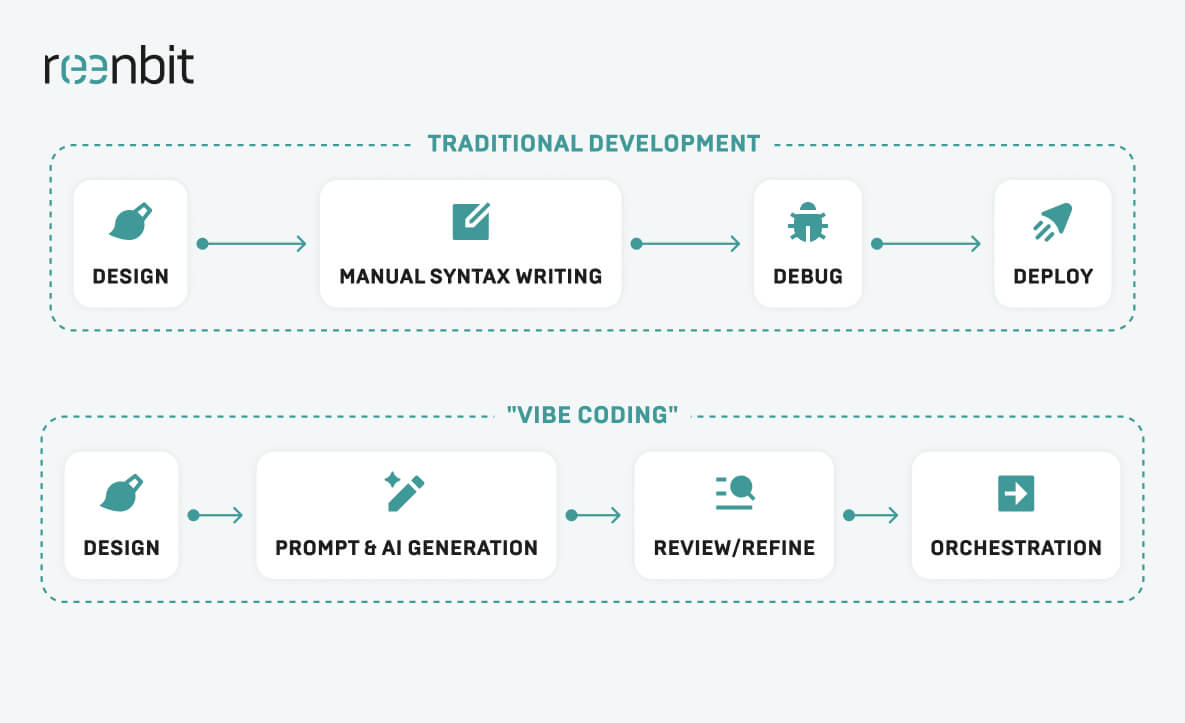
Speed to Market vs. Architectural Integrity
Vibe coding accelerates the initial phases of the software development lifecycle. Engineering teams can spin up functional prototypes, build microservices, and implement standard frontend components with exceptional speed. Such acceleration provides a tremendous initial boost to a company’s speed to market, enabling product teams to rapidly validate features in real-world scenarios.
Simultaneously, this speed may come at the direct expense of long-term architectural integrity. Generalized off-the-shelf AI tools focus mostly on answering the immediate prompt in isolation. They lack a complete understanding of systemic dependencies, technical debt optimization, and long-term architectural health.
Another important issue is the developers’ reliance on conversational code generation and their avoidance of appropriate structural oversight. By doing that, developers transform codebases into fragmented, difficult-to-maintain ecosystems. Thus, the satisfaction of rapid feature delivery may obscure the gradual erosion of your system’s foundational architecture.
Why the 70% Reduction in Dev Costs Can Be Deceptive
Many commercial AI providers prominently market statistics claiming a 50-70% reduction in software engineering timelines or development costs. These metrics may hold true for isolated tasks such as:
- Generating basic CRUD operations
- Writing standard unit tests
- Handling boilerplate integrations
However, applying this figure across an entire enterprise lifecycle is often highly deceptive.
A large share of a software system’s lifetime costs is always spent on maintenance, scaling, and debugging. With the help of a robust AI tool, developers can build a feature 70% faster. But if that code introduces subtle concurrency bugs, optimization bottlenecks, or security vulnerabilities, the subsequent engineering hours required to isolate and fix bugs will quickly erase those early financial savings.
Thus, measuring real engineering efficiency based on the volume of code generated per hour is impossible. Here, the stability of your software, its security, and long-term maintainability within the production environment are among the key factors to consider during such an evaluation.
Strategic Decision Guide: When to Buy vs. When to Build
Approaching the when to build vs buy AI agents question requires analyzing how your software engineering efforts immediately impact your market status and operational system.
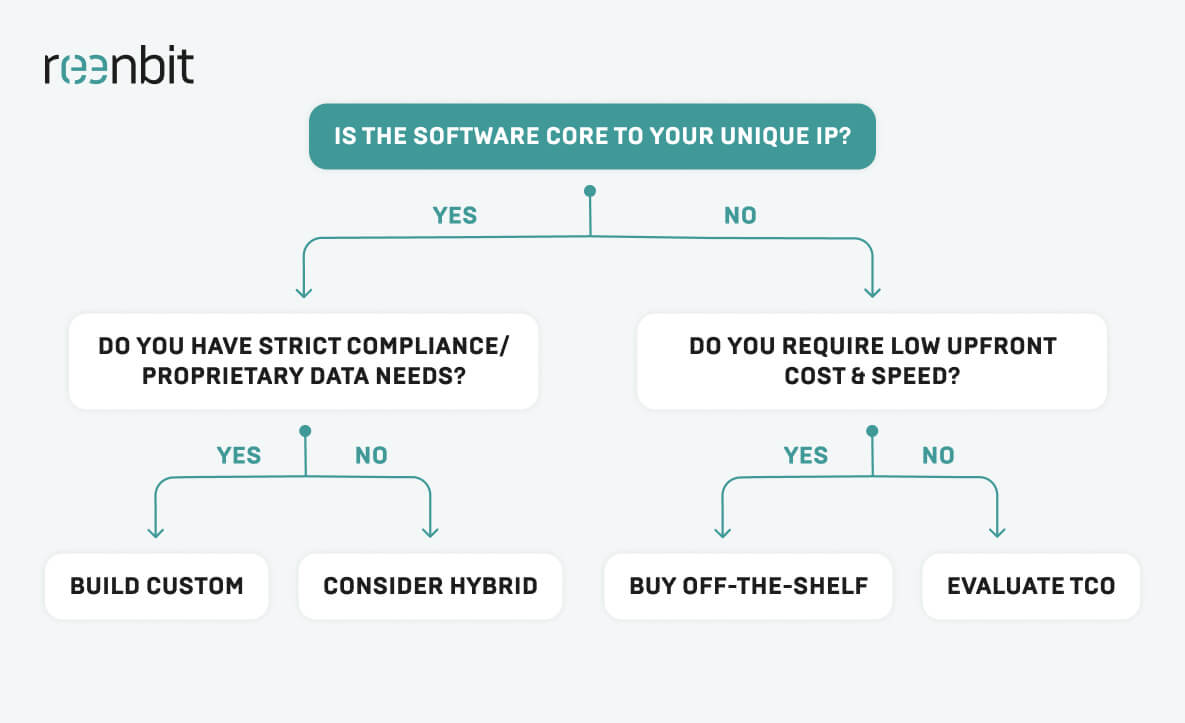
Choose Off-the-Shelf If: Speed, General Utilities, and Low Overhead Are Priorities
Choosing a ready-made external solution is usually the best option when software development supports, rather than defines, your core product.
- Standard Applications. For those building standard business applications, generic web portals, and internal tools, an off-the-shelf platform provides vital engineering support without added complexity.
- Rapid Prototyping Needs. Early-stage startups and innovation labs that need quick validation of product-market fit can get benefits from the speed of commercial tools.
- Resource Constraints. Organizations without dedicated data engineering teams or machine learning infrastructure should avoid custom model deployment. Using a pre-built solution enables access to advanced AI capabilities without distracting from core business objectives.
Invest in Custom Build If: Data Privacy, Strict Security Compliance, and Unique IP Are Non-Negotiable
- Protecting Core IP. If your business model relies on highly proprietary algorithms, novel architectural frameworks, or specialized logic, exposing those codebases to external models poses an existential threat to your long-term market position.
- Complex Internal Ecosystems. Large enterprises with extensive legacy systems, custom frameworks, and niche languages often find public models inadequate. A custom system trained on internal repositories will deliver the contextual accuracy that cannot be matched by public tools.
- Regulated Sectors. Organizations subject to strict regulations (HIPAA, GDPR) or defense-level security should not send source code or internal data to third-party APIs. Deploying a custom solution in a private cloud ensures data sovereignty.
The Blind Spots: Risk Analysis of Off-the-Shelf Coding Tools
You need to follow deep structural guardrails when deploying commercial generative AI across an enterprise engineering department. Instead, you will face key organizational risks.
Intellectual Property (IP) Risks and Code Leakage
The primary risks of public AI tools are associated with data governance and the protection of proprietary assets. When developers feed code blocks, structural schematics, and internal system requirements into a commercial platform, they risk letting that data be absorbed into the vendor’s future training sets.
This creates a serious channel for potential code leakage. It means that fragments of your proprietary logic could theoretically appear as suggestions for developers at competing firms. Even when SaaS vendors offer tiers that promise to exclude user data from training pipelines, the act of transmitting source code to external servers creates a larger surface area for data security breaches.
Hallucinations in Systems of Record (Why Billing and Health Data Cannot Blindly Rely on AI)
Large language models operate on probabilistic prediction, meaning they generate responses based on statistical likelihood rather than absolute factual verification. Such an architectural reality leads to hallucinations. These are instances in which the AI generates code that appears syntactically perfect but is logically flawed, references nonexistent dependencies or contains subtle security flaws.
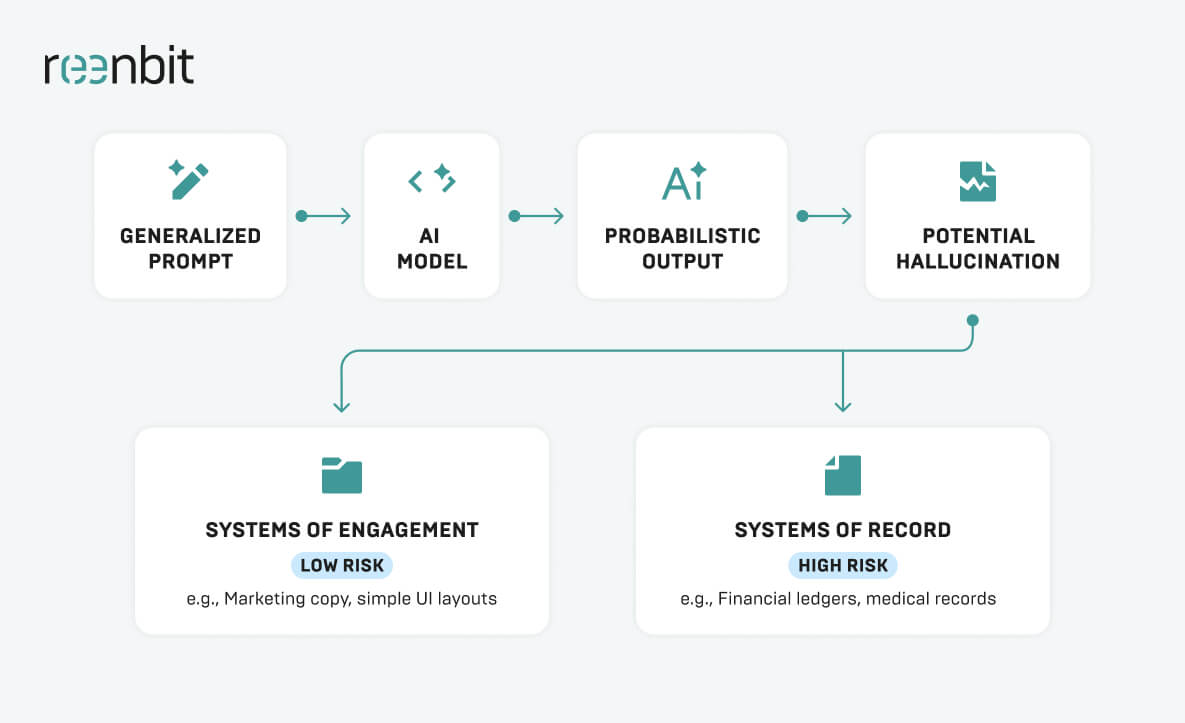 While a minor hallucination or UI rendering glitch in a system of engagement (such as a marketing landing page) is easily caught and fixed, the same error in a system of record can have catastrophic consequences.
Applications may often contain automated financial transactions, billing documents, customer records, or healthcare data analytics. So, they cannot afford a single unexpected logical deviation. You should not blindly trust AI-generated code in these highly sensitive environments. This can result in negative effects like massive data corruption, compliance liabilities, and severe systemic failures.
The Accumulation of “AI-Driven” Technical Debt
Because generative tools enable developers to rapidly generate large volumes of code with minimal manual effort, they inevitably accelerate the accumulation of technical debt. Software developers can quickly generate complex modules without completely understanding the underlying mechanics or long-term operational impact.
This leads to a sprawling codebase rife with duplicate logic, unoptimized database queries, and inefficient memory management. When the engineers who orchestrated these blocks move on to other projects, the remaining dev team must decipher a complex AI-generated architecture. Thus, you will spend time addressing the long-term maintenance burden that will affect your future innovations and drain valuable resources to keep the platform stable.
The Hybrid Framework: Reenbit’s Recommended Approach
The most sustainable, high-ROI solution lies in a structured hybrid model. At Reenbit, we have extensive and successful experience in robust digital transformation initiatives and advanced business intelligence frameworks. This has encouraged us to adopt a tiered approach and deliver high-quality AI-assisted software development services to our clients.
Reenbit’s strategy helps maximize developer velocity while strictly safeguarding company IP and architectural stability.
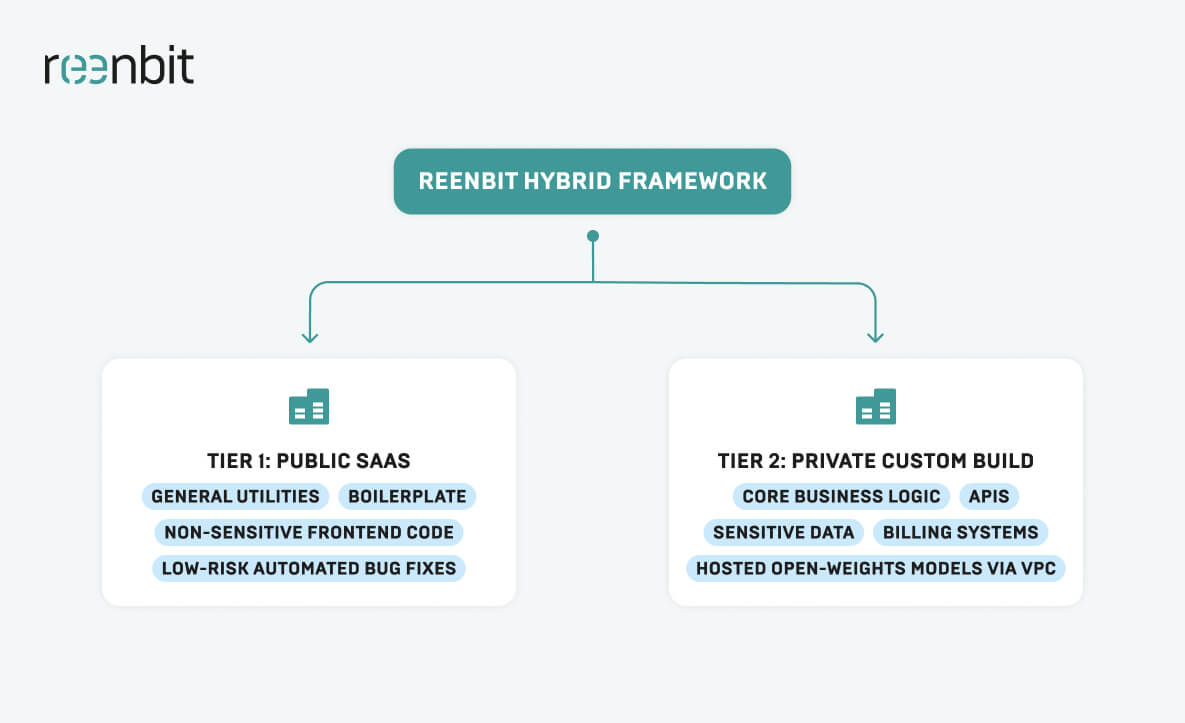
Our framework divides software development tasks based on critical factors such as security risk, system complexity, and core intellectual property value:
- Tier 1 – General Utilities via Public SaaS (Controlled Buying). We recommend that companies use an off-the-shelf solution for low-risk non-proprietary tasks. This includes generating basic test suites, drafting standard frontend layouts, creating simple documentation, or executing straightforward bug fixes. Such tasks leverage the high speed of public SaaS tools and expose no core business assets.
- Tier 2 – Core Proprietary Logic via Private Custom Build (Targeted Building). For the core engines of your application, we design and implement secure, internal AI workflows. By hosting lightweight, open-weight models entirely within the client’s private cloud environment and optimizing them via local RAG pipelines, we ensure that no sensitive data or source code ever leaves the corporate perimeter.
This hybrid approach allows tech leaders to optimize their total cost of ownership. Reenbit can keep seat-based SaaS licensing costs to a minimum while concentrating resources on custom AI capabilities that will deliver a genuine, long-term competitive advantage.
Conclusion: Moving From Execution to Orchestration
So, build vs buy generative AI solutions? The answer to this question will become a key definition of your development team’s future relationship with tech.
On the one side, relying on generalized, off-the-shelf tools can make you vulnerable to increasing subscription costs, vendor dependencies, and further architectural fragmentation. On the other hand, the attempt to build an all-encompassing internal platform from scratch can waste valuable funds on infrastructure maintenance. This does not directly align with your primary business goals.
The future of tech leadership encourages you to shift the focus from simple execution to strategic orchestration. By adopting a framework that fits ready-made software utilities with targeted, secure internal AI assets, your business will reach sustainable engineering velocity. At the same time, this will not affect data security or the architectural health of your software.
If you aim to evaluate your organization’s development stack and build a secure, long-term AI strategy, connect with our experts at Reenbit. We will help you design a reliable solution tailored precisely to your technical ecosystem and business objectives.
FAQ
What is "Vibe Coding" and how does it impact the build vs. buy decision?
“Vibe Coding” describes an emerging software development style where engineers step back from manual syntax writing and instead act as high-level directors. They converse with AI-powered tools in natural language to quickly generate, iterate, and deploy features.
Off-the-shelf tools provide immediate, high-velocity vibe coding environments for standard tasks, but they lack long-term architectural awareness. If your core business requires strict engineering control, you will need to build a custom or hybrid framework to prevent your codebase from becoming fragmented and difficult to maintain.
Are off-the-shelf AI coding tools safe for proprietary enterprise codebases?
Standard consumer tiers of off-the-shelf AI tools pose real security risks, as your code could be used to train future public models. While many vendors now offer enterprise-grade subscriptions that promise to keep your data private, your source code must still be sent to external servers for processing.
For companies subject to strict regulatory and data-sovereignty requirements, using public SaaS tools can lead to negative consequences. In these scenarios, the best recommended way is to build a custom internal solution and host it in your own secure VPC.
What are the hidden costs of building a custom AI coding assistant?
You might drop the monthly per-user SaaS fees, but you trade them for heavy backend expenses. The real price tag comes from:
-
-
- Hiring specialized data engineers and machine learning talent
- Paying for dedicated GPU infrastructure to keep response times fast
- Dealing with the ongoing headache of updating your vector databases
-
On top of that, your team has to constantly monitor model drift to ensure the assistant does not start ignoring your updated style guides and coding standards.
Can ready-made AI coding tools fully replace traditional software engineers?
No. Off-the-shelf tools can generate basic boilerplate, run simple unit tests, or perform a quick sanity check during a code review. But they lack strategic thinking and architectural foresight. Also, they have no real problem-solving skills. Thus, AI coding tools are just changing jobs. Developers are moving away from typing out repetitive syntax and starting to focus more on high-level system design, security validation, and project orchestration.
For what types of software should companies avoid relying strictly on AI coding tools?
Keep AI away from your core systems of record. This means your financial ledgers, billing engines, encryption layers, or anything touching highly sensitive customer records and medical data. Because these models rely on statistical guessing, they will eventually hallucinate. A tiny, hard-to-spot logic error in a billing pipeline or database schema can trigger major data corruption, compliance fines, and massive financial liabilities.

