
AI Application Maintenance: Monitoring, Updates, and Ongoing Costs
Modern applications are never really “done.” The moment you ship new code, the real work begins. Every feature, integration, API, and framework update adds another potential failure point to your software applications. It’s no surprise that engineers now spend around 30% of their time dealing with disruptions, while major outages can cost businesses up to $1.9 million per hour.
That’s exactly why AI has become such a valuable part of modern application maintenance. It helps teams spot problems before they turn into unplanned downtime, automate repetitive work, and spend less time firefighting.
In this guide, we’ll explore how AI is transforming application maintenance, what it costs, where it delivers the biggest value, and what to consider before adopting it.
What Is AI Application Maintenance?
AI application maintenance uses artificial intelligence to help keep applications reliable after deployment. Using machine learning models, it continuously analyzes application data to detect issues early, automate routine maintenance tasks, and support faster troubleshooting. Rather than replacing engineers, it reduces manual operational work and helps teams respond to problems before they become outages.
How AI Improves the Process of Application Monitoring
AI in application monitoring works by analyzing large volumes of telemetry. It identifies anomalies and speeds up troubleshooting.
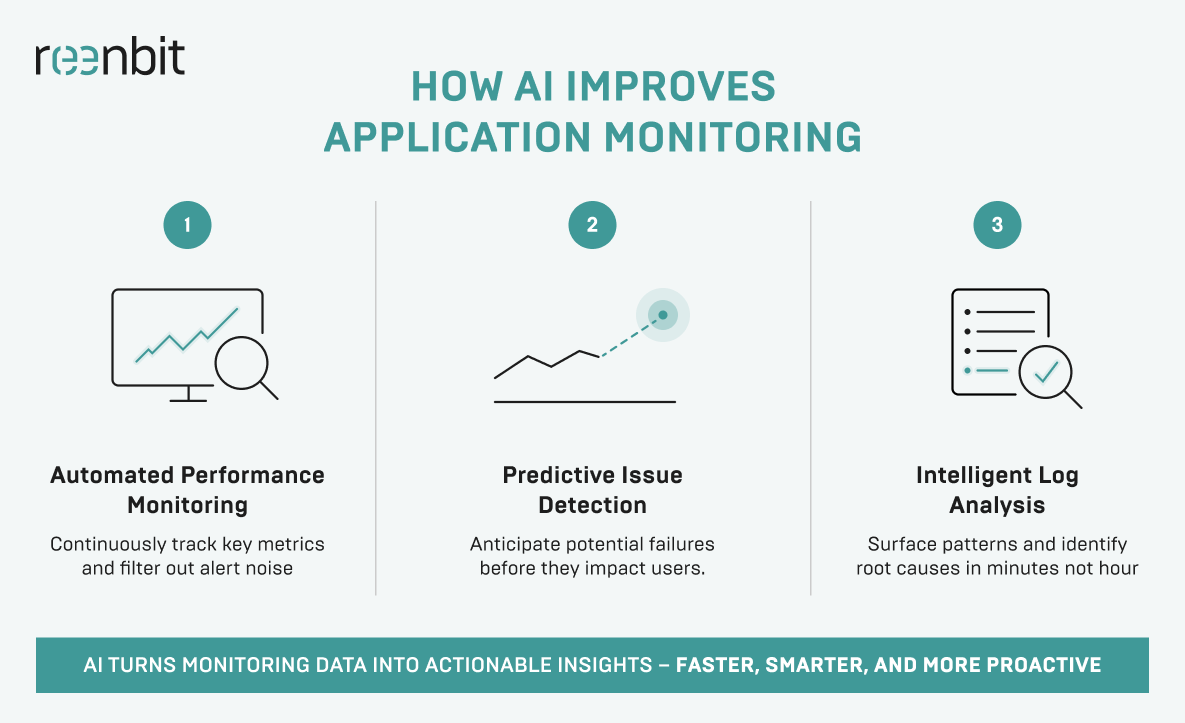
Automated Performance Monitoring
AI-powered tools track response times, error rates, and resource usage across every service, around the clock. For many teams, the biggest challenge isn’t collecting monitoring data; it’s dealing with the flood of alerts.
Dynatrace found that organizations receive an average of 2,973 monitoring alerts every day, but only 26% require action. By learning what’s normal for each application, from daily traffic peaks to deployment activity and seasonal demand, machine learning algorithms can suppress false positives and surface the alerts that actually need attention automatically.
Predictive Issue Detection
AI doesn’t wait for something to fail. By comparing real-time data with historical data, it can predict potential failures (a memory leak, a slowing database, or rising latency) before they cause an outage.
Netflix demonstrated this proactive approach with Scryer, which forecasts traffic demand and provisions capacity before demand spikes. Today, predictive analytics is built into many AIOps platforms, helping teams prevent incidents instead of responding to them, a clear example of AI’s role shifting from reactive to preventive.
Intelligent Log Analysis
A mid-sized application can generate millions of log entries every day. Reviewing them manually is time-consuming and not practical. AI can group related errors, surface unusual patterns, and identify the most likely root cause in minutes instead of hours. Many platforms now pair this analysis process with generative AI, making it possible to summarize incidents and offer troubleshooting assistance in plain English.
Traditional Maintenance: Key Differences
The contrast becomes concrete side by side:
Aspect
Traditional Maintenance
AI App Maintenance
Issue detection
Reactive: problems surface after users complain
Proactive: anomalies flagged from real-time data
Monitoring
Manual dashboard checks during working hours
Automated systems watching 24/7
Root cause analysis
Hours of digging through application logs
Automated correlation across system logs in minutes
Updates and patches
Scheduled manual maintenance windows
Automated patch management with risk scoring
Scaling
Headcount grows with the app portfolio
Cost grows far more slowly than coverage
Team focus
Firefighting and repetitive tasks
Architecture, prevention, and improvement
Issue detection
Traditional Maintenance: Reactive: problems surface after users complain
AI App Maintenance: Proactive: anomalies flagged from real-time data
Monitoring
Traditional Maintenance: Manual dashboard checks during working hours
AI App Maintenance: Automated systems watching 24/7
Root cause analysis
Traditional Maintenance: Hours of digging through application logs
AI App Maintenance: Automated correlation across system logs in minutes
Updates and patches
Traditional Maintenance: Scheduled manual maintenance windows
AI App Maintenance: Automated patch management with risk scoring
Scaling
Traditional Maintenance: Headcount grows with the app portfolio
AI App Maintenance: Cost grows far more slowly than coverage
Team focus
Traditional Maintenance: Firefighting and repetitive tasks
AI App Maintenance: Architecture, prevention, and improvement
Neither model removes people. Automated systems handle scale and speed; human intelligence still owns judgment, architecture, and edge cases.

Want to Make Application Support More Predictable?
AI-Powered Application Updates and Optimization
AI supports more than monitoring. It also helps review code, automate testing, manage deployments, and optimize applications after release, reducing manual effort throughout the maintenance lifecycle.
AI-Assisted Code Review and Bug Detection
AI reviews code before it reaches human reviewers, identifying bugs, security vulnerabilities, and coding issues early. McKinsey estimates that generative AI can improve software development productivity by 20% to 45%, largely by reducing time spent coding, debugging, refactoring, and root cause analysis.
One example is Reenbit’s Microsoft Dynamics 365 analytics platform. The company used AI-assisted development throughout the project, helping the team deliver all three milestones on schedule.
Automated Testing and Release Management
AI can generate test cases, prioritize high-risk scenarios during the testing phase, estimate deployment risk, and automate rollback or patch management, helping teams release software faster while reducing manual effort needed at each step.
Continuous Application Optimization
After deployment, AI continues analyzing application performance, optimizing resource usage and caching based on real-world traffic and user behavior. These ongoing adjustments improve performance while lowering operational costs.
These changes are often small, but they add up over time. Better performance, fewer manual adjustments, and significant cost savings all contribute to a more efficient application and help drive continuous improvement.
How to Implement AI in Application Maintenance Workflows
Most teams don’t adopt AI all at once. They start with monitoring, then expand automation in application maintenance as they build confidence. Here’s how you can do the same:
- Audit your telemetry. AI depends on high-quality metrics, traces, and logs. Missing telemetry limits what it can detect.
- Start with monitoring. Anomaly detection and alert prioritization usually deliver the quickest results with the lowest risk.
- Introduce predictive analytics. Train machine learning models on historical data to forecast failures, capacity issues, and performance bottlenecks.
- Automate proven workflows. Start with runbook recommendations, then let ai driven automation handle routine responses once they’re well tested.
- Measure the results. Track incident resolution times, downtime, and cost per incident to measure the impact of each step.
Organizations without in-house AI expertise often work with AI development services or hire AI developer talent to support implementation and ongoing optimization.
Main AI Use Cases for App Maintenance
AI can improve application maintenance in almost any environment, but the biggest gains tend to come from systems that are complex, distributed, or heavily regulated. Here are three areas where AI is already helping teams do more.
Enterprise Applications
Enterprise applications often depend on hundreds of connected systems, so incident management gets complicated fast, a problem in one service can quickly affect others. AI helps detect issues early, identify the likely root cause, and prioritize incidents before they become larger outages. Reenbit’s work transforming a U.S. retailer with an AI-powered data platform shows how unifying fragmented systems cut reporting time by 70%.
SaaS Platforms
For SaaS platforms, unplanned downtime directly affects customers. AI runs real time monitoring across thousands of users, detects unusual traffic patterns, identifies performance issues, and helps teams scale infrastructure before demand exceeds capacity, protecting the reliability that becomes a competitive edge.
Healthcare and Financial Software
Healthcare and financial applications operate under strict security and compliance requirements, where security incidents and data breaches carry legal consequences. AI helps detect suspicious activity, identify unusual access patterns from user interactions, and monitor systems for potential security threats. It can also maintain audit logs for compliance, although critical decisions still require human oversight.
How Much Does AI Application Maintenance Cost?
Costs depend on application size, telemetry volume, and the level of automation required. Most organizations budget for three areas:
- Software. AIOps and observability platforms range from a few hundred dollars per month for smaller deployments to enterprise pricing based on monitored infrastructure or data volume. For example, PagerDuty AIOps starts at $699/month, while IBM Instana pricing starts at $21.20 per monitored virtual server per month.
- Implementation. Integrating monitoring tools, configuring automation, and tuning AI models is typically the largest upfront investment.
- Operations. Ongoing costs include licenses, cloud infrastructure, model updates, and periodic tuning.
However, while implementation requires an upfront investment, organizations typically recover costs through fewer incidents, faster root cause analysis, and less manual work. This improves operational efficiency and, for applications where availability equals revenue, delivering substantial cost savings by preventing costly downtime.
Challenges of Using AI in Application Monitoring
Despite the benefits, AI is not a plug-and-play solution. Its effectiveness depends on high-quality data, strong governance, and appropriate human oversight.
Data Quality and Integration
AI depends on accurate data. Gartner predicts that through 2026, 60% of AI projects will fail because organizations lack AI-ready data. Fragmented telemetry, inconsistent tagging, and disconnected logs reduce accuracy, leading to false alerts and missed incidents.
Security and Human Oversight
AI can automate routine maintenance, but production changes still require human oversight. Clear approval workflows, audit logs, and regular model reviews help reduce human error, contain security risks, and keep automated decisions accountable.
How Much Does AI Application Maintenance Cost?
Costs depend on application size, telemetry volume, and the level of automation required. Most organizations budget for three areas:
- Software. AIOps and observability platforms range from a few hundred dollars per month for smaller deployments to enterprise pricing based on monitored infrastructure or data volume. For example, PagerDuty AIOps starts at $699/month, while IBM Instana pricing starts at $21.20 per monitored virtual server per month.
- Implementation. Integrating monitoring tools, configuring automation, and tuning AI models is typically the largest upfront investment.
- Operations. Ongoing costs include licenses, cloud infrastructure, model updates, and periodic tuning.
However, while implementation requires an upfront investment, organizations typically recover costs through fewer incidents, faster root cause analysis, and less manual work. This improves operational efficiency and, for applications where availability equals revenue, delivers substantial cost savings by preventing costly downtime.
Challenges of Using AI in Application Monitoring
Despite the benefits, AI is not a plug-and-play solution. Its effectiveness depends on high-quality data, strong governance, and appropriate human oversight.
Data Quality and Integration
AI depends on accurate data. Gartner predicts that through 2026, 60% of AI projects will fail because organizations lack AI-ready data. Fragmented telemetry, inconsistent tagging, and disconnected logs reduce accuracy, leading to false alerts and missed incidents.
Security and Human Oversight
AI can automate routine maintenance, but production changes still require human oversight. Clear approval workflows, audit logs, and regular model reviews help reduce human error, contain security risks, and keep automated decisions accountable.
Best Practices for Implementing AI in Application Support
A few AI application maintenance best practices help teams introduce AI gradually and focus on measurable improvements:
- Set clear goals, such as reducing downtime or MTTR.
- Start with routine tasks like alert triage and log analysis.
- Keep people involved in production decisions.
- Retrain models as applications evolve.
- Review AI recommendations regularly to build trust over time.
Takeaway: The Future of AI Application Maintenance
AI is moving beyond monitoring and recommendations toward handling more maintenance tasks with less human involvement. While Gartner expects more than 40% of agentic AI projects to be canceled by the end of 2027, organizations continue to invest in AI systems for incident detection, root cause analysis, and workflow automation.
As the technology matures, AI will take on more routine work through AI-driven tools and virtual assistants for on-call engineers. Human teams will still oversee production systems, but much of the repetitive work is likely to become increasingly automated. For a closer look at where this is heading, see how AI is transforming software development.
FAQ
How does AI help with application monitoring?
AI analyzes metrics, traces, and logs to detect anomalies, identify patterns, and speed up root cause analysis before issues affect users.
Does AI reduce software maintenance costs?
Yes. It reduces operational costs by automating routine tasks, shortening incident resolution times, and helping prevent downtime.
Can AI replace application maintenance teams?
No. AI automates repetitive work, but engineers still handle architecture decisions, complex problems, and production oversight.
What AI tools are used for application maintenance?
Common tools include AIOps platforms, AI code assistants, automated testing tools, and generative AI copilots for incident analysis and troubleshooting.
What are the benefits of AI-powered application maintenance?
Key benefits include less downtime, faster incident resolution, higher productivity gains for engineers, and lower operating costs.

