Background
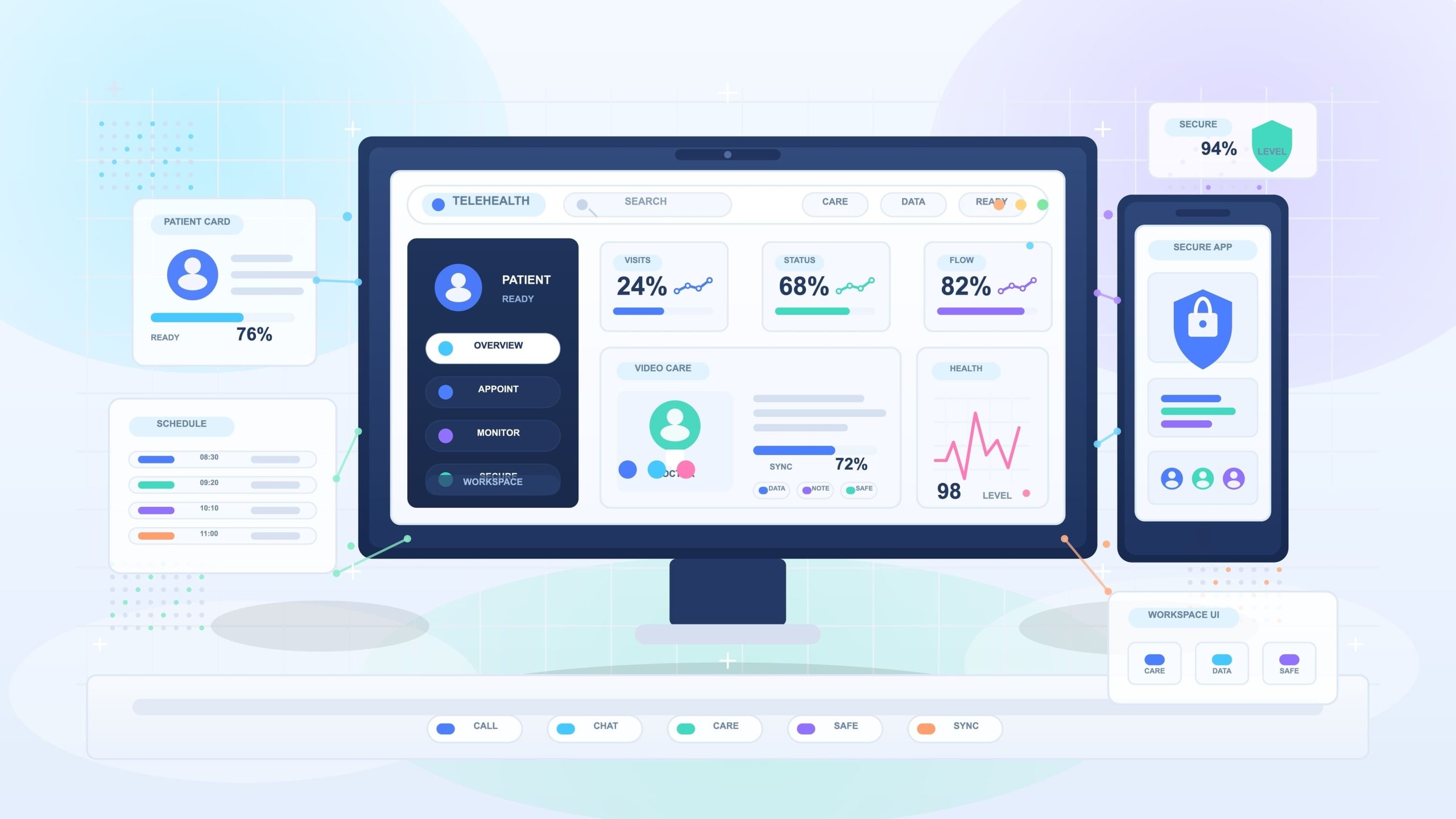
The growing demand for remote healthcare solutions has created a need for a platform that enables medical professionals to monitor patient health, assess symptoms, and ensure proper medical billing. Our client, a US Startup, is a digital health platform designed to simplify and enhance the delivery of preventative and value-based care. Integrating various apps, devices, and features into a single system empowers healthcare providers to easily create and manage digital care programs.
The platform leverages AI and automation to streamline remote care, making it more convenient for both patients and healthcare professionals. This platform was developed to provide a seamless connection between patients and healthcare providers while optimizing workflows for medical staff.
The Client engaged Reenbit in March 2024 to build a production-grade web and mobile platform that meets US healthcare requirements (HIPAA, HITECH, MACRA) plus GDPR for international use, while supporting the full spectrum of CMS reimbursement codes. Our team joined as an extended product engineering unit, taking ownership of the cloud architecture, full-stack web platform, cross-platform mobile app, AI-driven patient engagement, device and EHR integrations, and ongoing support. The cooperation has been continuous since launch and remains active today.
Challenges
Patient data had to flow into the platform consistently across a fragmented device ecosystem — Bluetooth-paired home devices (BP monitors, glucometers, scales, pulse oximeters), vendor cloud APIs, wearables (Apple Watch, Apple Health, Google Fit), and patient-uploaded photos of meter readings. Each pathway had its own latency, reliability, and validation rules, and abnormal values had to be flagged and routed to the right team member in near real time.
Operating within the US, telemedicine added significant regulatory complexity on top of the engineering work. HIPAA, HITECH, MACRA, and GDPR had to be designed into every layer of the system, alongside SOC 2 Type II controls, ISO 27001, WCAG 2.1 AA accessibility, MFA, and full audit logging. The billing logic carried similar weight — RPM, RTM, APCM, CCM, PCM, and TCM each have distinct CPT codes, time-tracking and documentation rules, and the platform had to automatically assign clinical activity to the correct code and generate insurance-ready reports without manual reconciliation.
On top of that, the platform had to behave like a true digital extension of the clinic — integrating bidirectionally with EHRs over HL7 v2.x, FHIR R4, and USCDI v3, supporting TEFCA / QHIN in the US and ABDM in India, while a white-label theming engine let any clinic rebrand the entire product with full per-tenant data isolation. And the patient experience had to stay simple for users ranging from technically comfortable adults to elderly chronic-care patients — multi-language, offline-capable, gamified, with a target of well under a minute for daily monitoring tasks.
Solution
We built a HIPAA-, GDPR-, and MACRA-compliant digital care platform on Azure that lets clinics launch a fully digital extension of their practice in a single white-label product. The architecture was healthcare-native from day one, with FHIR data structures, fine-grained role-based access, multi-tenant theming, and a cross-platform mobile experience powered by a shared React / React Native codebase. The solution is organized around six pillars:
- Cloud architecture & FHIR foundation and Business Central
Azure-native, HIPAA-aligned stack using Azure Health Services (FHIR), Azure Container App Environments, Private Networks, Azure Front Door and Application Insights. Designed for multi-tenant deployment with full per-clinic data isolation and white-label theming.
- AI-Capture & AI Agent
AI-Capture pipeline (Azure Cognitive Services + OpenAI) extracts, validates and normalizes readings from photos of any FDA-approved device. A separate AI Agent automatically re-engages non-compliant patients via SMS and WhatsApp, delivering assessments and recovering missing readings — protecting CMS reimbursement without adding staff overhead.
- Device, wearable & EHR interoperability
Direct integrations with OMRON (Bluetooth + cloud), Dexcom (cloud), pulse oximeters, weight scales, Apple Health, Apple Watch, and Google Fit for hands-off vitals ingestion. EHR / EMR interoperability over HL7 v2.x, FHIR R4, and USCDI v3, plus TEFCA / QHIN in the US and ABDM in India, with REST APIs, OAuth 2.0, and webhooks.
- Telehealth & care-team communication
Azure Communication Services power one-click video and audio calls, scheduled and ad hoc sessions, session recording, async telehealth, HIPAA-compliant chat, group chat for the monitoring team, internal staff-to-staff messaging, and one-click case escalation — all anchored to the clinic’s organizational time zone to avoid time zone drift across US states.
- CPT-aligned billing & clinical workflow
Automated time-tracking and CPT-code-assignment engine maps every clinical activity to the right code across six CMS programs — RPM, RTM, APCM, CCM, PCM, TCM — and produces insurance-ready billing reports plus weekly program-compliance reports per organization. Includes monitoring tracks, a custom exercise prescription with video, and caregiver roles for inpatient and home care settings.
- Patient engagement & accessibility
Gamification (streaks, achievement badges), PROMs / PREMs collection for value-based care, conditional-logic assessments, digital consent forms, a guided Training Mode for new and elderly patients, a multi-language interface, and offline capability with auto-sync. Tuned for under-15-second daily check-ins.
Features
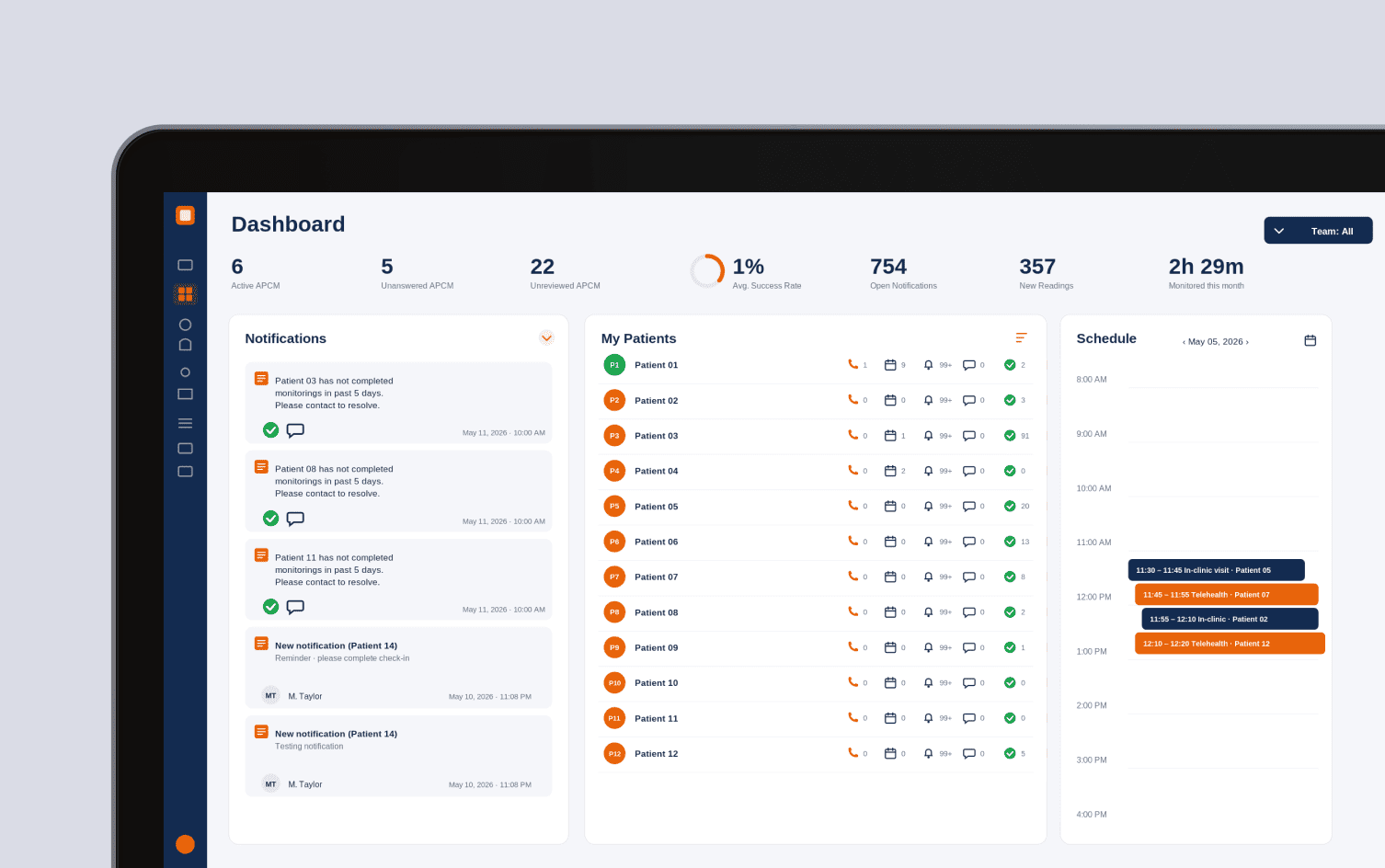
A compact view of what was built across the staff portal and patient mobile app.
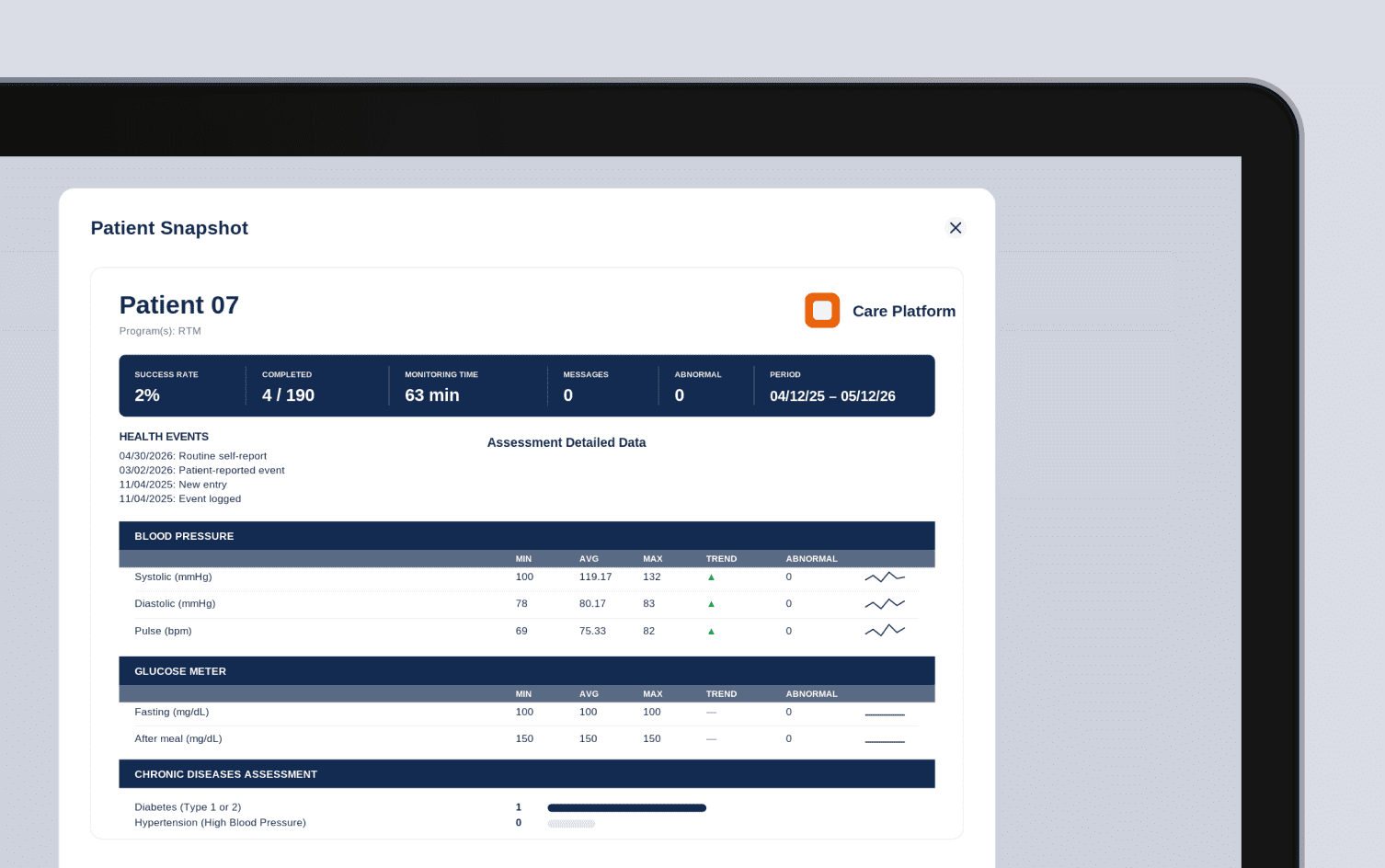
Remote Patient & Therapeutic Monitoring:
- Continuous vitals from OMRON, Dexcom, pulse oximeters, scales, and wearable trackers (Apple Watch, Apple Health, Google Fit).
- AI-Capture for validating readings from a photo of any FDA-approved device.
- Threshold-based alert visualization with abnormal-reading highlighting and routing.
Patient Engagement & Assessments:
- PROMs / PREMs, conditional-logic assessments, digital consent forms, and pre-visit data collection.
- Gamification: streaks, achievement badges, motivational messaging.
- Multi-language UI, offline mode with auto-sync, and guided Training Mode.
Communication & Telehealth:
- HIPAA chat, group chat, internal staff-to-staff messaging, one-click case escalation.
- Scheduled and ad-hoc video / audio calls with session recording; asynchronous telehealth.
- Broadcast messaging and population notifications, segmented and schedulable.
AI-Driven Compliance & Workflow:
- AI Agent re-engaging non-compliant patients via SMS / WhatsApp.
- Automated SMS invitations, bulk patient import, and automated CPT-code recognition.
Clinical Operations & Billing:
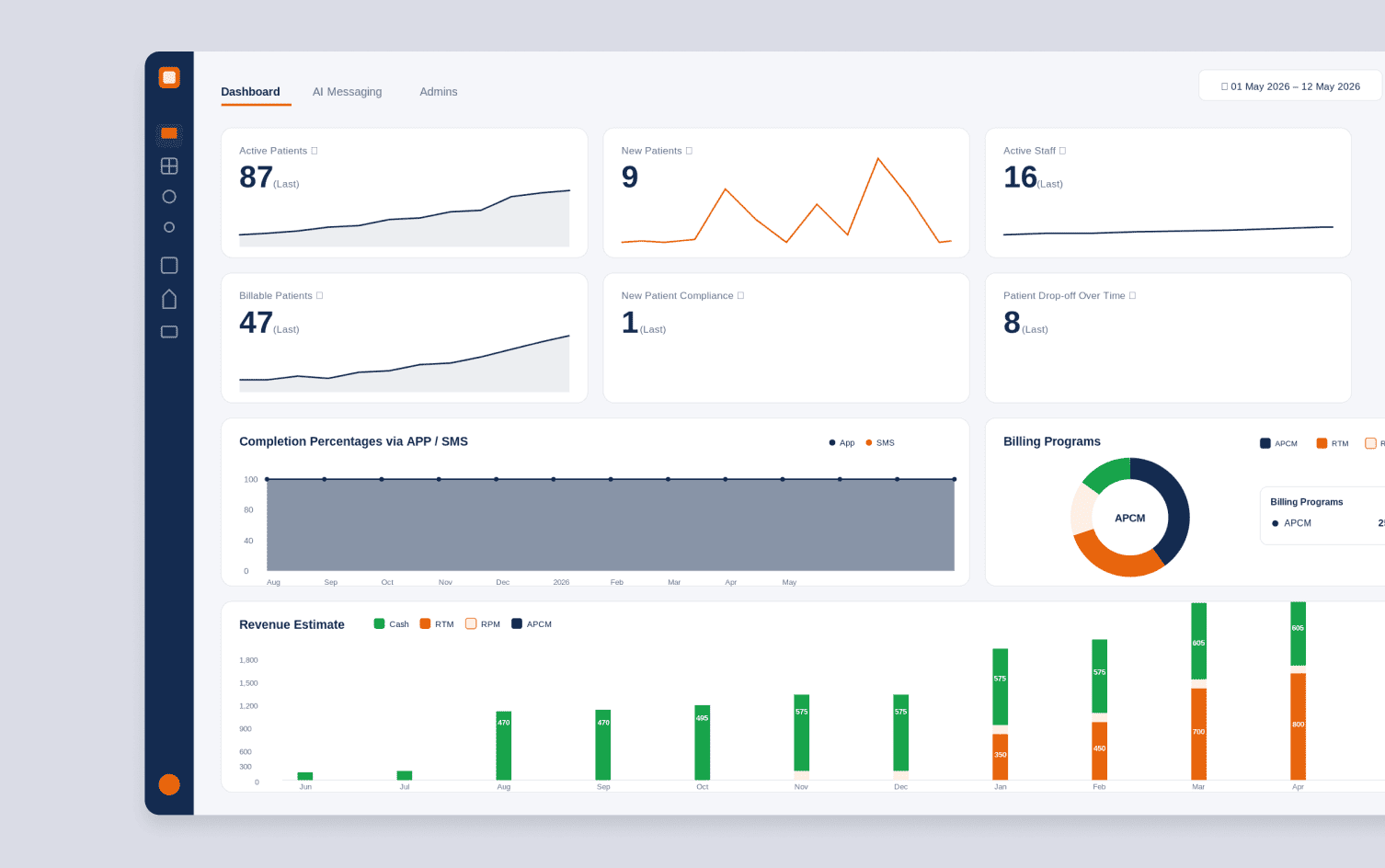
- CPT billing across RPM, RTM, APCM, CCM, PCM and TCM with automatic code assignment.
- Weekly program-compliance reports per organization; multi-office and multi-team management.
- Monitoring tracks, custom exercise prescription with video, caregiver roles, white-label branding.
Integrations & Interoperability:
- HL7 v2.x, FHIR R4, USCDI v3; TEFCA / QHIN (US), ABDM (India).
- REST APIs, OAuth 2.0, webhooks for third-party tools.
Security & Compliance:
- HIPAA, HITECH, MACRA, GDPR, SOC 2 Type II, ISO 27001, WCAG 2.1 AA.
- MFA, end-to-end encryption, and role-based access control with full audit logging.
Timeline
The platform was delivered in three rolling phases, with the team continuously shipping to production from month three onward:
Months 1–3 · Foundation
- Azure cloud setup, FHIR data model, ASP.NET Identity, role-based access foundations, MVP web portal and patient mobile app, first OMRON and Dexcom integrations, RPM and RTM CPT-code wiring.
Months 4–8 · Scale & interoperability
- APCM, CCM, PCM, and TCM billing programs, EHR integration over HL7 / FHIR R4 / USCDI v3, broader device ecosystem (Apple Health, Apple Watch, Google Fit, pulse oximeters, scales), white-label theming engine, multi-office and multi-team management.
Months 9+ · AI engagement & ongoing evolution
- AI Agent for SMS / WhatsApp re-engagement, AI-Capture pipeline, gamification (streaks and badges), PROMs / PREMs, multi-language UI, weekly compliance reports, TEFCA / QHIN and ABDM connectivity, and continuous feature evolution.
Outcome
Reenbit’s technical expertise helped optimize the platform’s architecture, integrate AI-driven automation, and ensure full compliance with U.S. telemedicine regulations.
- 6 CMS reimbursement programs supported in production — RPM, RTM, APCM, CCM, PCM, TCM — covering 19+ distinct CPT codes.
- Administrative workload for medical staff was reduced by 35%, allowing clinics to focus more on proactive patient care.
- Patient-provider communication improved by 40%, enabling faster response times and better engagement.
- 1 AI Agent re-engaging non-compliant patients over SMS and WhatsApp, raising adherence and protecting CMS reimbursement without adding staff overhead.
- Billing accuracy and efficiency increased by 50%, with care activities now automatically mapped to appropriate CPT codes.